Five drinking waters and six natural mineral waters
This is a practical shelf guide, not a claim about Thailand's ten best-selling waters. AllOnline's “popular” sorting is a storefront order, not audited national sales data, and delivery stock does not mirror every 7-Eleven branch.
The core comparison uses products found in the official AllOnline drinking-water catalog, its natural mineral-water category, or an official manufacturer source that names 7-Eleven distribution. Namthip is the exception in the other direction: it did not appear in the online snapshot, but the supplied photographs verify a real 1.5 L bottle in store and the observed shelf price was ฿14 on 19 August 2026.
The World Health Organization notes that drinking water can contribute calcium and magnesium, but bottled waters vary widely in mineral concentration. Without current mineral panels for all eleven exact bottles, this guide does not award health points for the word “mineral,” alkaline pH, or vague wellness language.
The evidence scorecard
Instead of forcing incomplete evidence into a numerical ranking, every conclusion has to clear the same five checks.
| Check | What counts | What does not count |
|---|---|---|
| 7-Eleven evidence | Exact AllOnline listing, supplied in-store label photo, or a manufacturer document naming 7-Eleven. | Assuming every Thai supermarket product is stocked at 7-Eleven. |
| Comparable price | Case price divided by total case litres, using the non-promotional list price where shown. | Comparing a promotional case price directly with an unverified single-bottle shelf price. |
| Water type | The official product category: drinking water or natural mineral water. | Treating “premium,” “alkaline,” or a higher price as proof of superior hydration. |
| Transparency | A specific filtration process, named natural source, current label, or material disclosure. | Unquantified detox, beauty, cell-balance, or immunity marketing. |
| Use-case fit | Bottle size, portability, case value, and whether the shopper needs water or meaningful electrolyte replacement. | A universal winner for every person and workout. |
Catalog and observed shelf comparison
Most prices below are reference case prices captured from official AllOnline pages around 19 August 2026. Namthip is the clearly marked exception: a single-bottle shelf observation supplied from a 7-Eleven visit. Promotions and branch prices change. Aura is retained from manufacturer distribution evidence, but its exact bottle still needs a shelf-price recheck.
| Product | Type | Compared size | Purchase reference | Reference price/L | Availability evidence | Guide result |
|---|---|---|---|---|---|---|
| 7-Select | Drinking water | 600 mL | 12 for ฿116 | ฿16.11 | Exact AllOnline listing | Best stable online case value |
| Nestlé Pure Life | Drinking water | 600 mL | 12; ฿130 list | ฿18.06 | Exact AllOnline listing | Strong process disclosure |
| Crystal | Drinking water | 600 mL | 12; ฿130 list | ฿18.06 | Exact AllOnline listing | Mainstream option |
| Singha | Drinking water | 600 mL | 12; ฿130 list | ฿18.06 | Exact AllOnline listing | Documented filtration |
| Namthip | Drinking water | 1.5 L | 1 bottle for ฿14† | ฿9.33† | Exact bottle and shelf price observed in store | Best observed large-bottle value |
| All Spring | Natural mineral water | 600 mL | 12 for ฿103* | ฿14.31* | Exact AllOnline listing | Potential value; verify checkout |
| Purra | Natural mineral water | 1.5 L | 6; ฿210 list | ฿23.33 | Wider AllOnline water listing | Large mineral-water format |
| 7-Select | Natural mineral water | 500 mL | 12; ฿170 list | ฿28.33 | Exact AllOnline listing | Private-label mineral option |
| Minéré | Natural mineral water | 500 mL | 12; ฿200 list | ฿33.33 | Exact AllOnline listing | Packaging documentation |
| Mont Fleur | Natural mineral water | 500 mL | 12; ฿278 list | ฿46.33 | Exact AllOnline listing | Named-source premium |
| Aura Active | Natural mineral water | 800 mL | Shelf recheck needed | — | Tipco names 7-Eleven distribution | Workout-size candidate |
*The current All Spring category snapshot displays ฿103 without a crossed-out regular price, while older captures showed materially different amounts. We preserve the current figure but do not crown it the value winner until it is confirmed at checkout. †Namthip is a single-bottle 7-Eleven shelf observation, not an AllOnline case listing; the same ฿14 reference also appears at Big C. Normalized prices are our arithmetic and rounded to two decimals.
What to choose by use case
฿116 for twelve 600 mL bottles in the reference listing, or about ฿16.11 per litre.
฿14 for the photographed single bottle, or ฿9.33 per litre. Recheck locally because branch prices can change.
Both publish a named microfiltration process. That is useful transparency, not proof that competing sealed waters are unsafe.
The manufacturers identify Phu Kham in Phetchabun, Phop Phra in Tak, and Phra Ngam in Sing Buri respectively.
Nestlé documents the brand's recycled-PET program. Confirm the exact bottle in hand because packaging transitions can vary by size and batch.
For most workouts under 60–90 minutes in normal conditions, the expensive mineral bottle is not a required performance upgrade.
Eleven product verdicts
The order starts with the best observed large-bottle value, then moves through ordinary drinking waters and natural mineral waters. The result column gives evidence-based use-case verdicts rather than a misleading universal numerical score.
Best observed large-bottle value
Namthip Drinking Water, 1.5 L
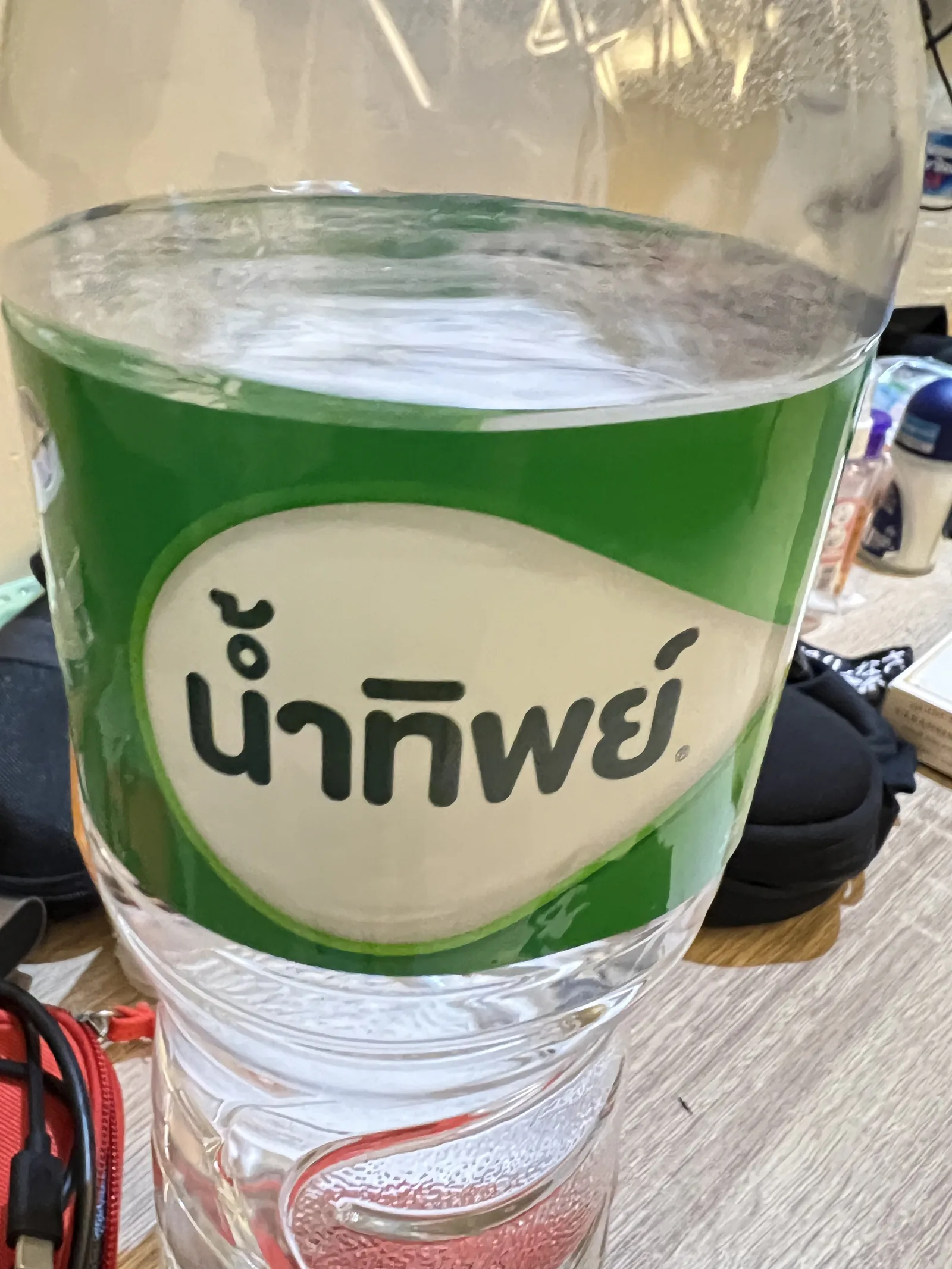 Open front label
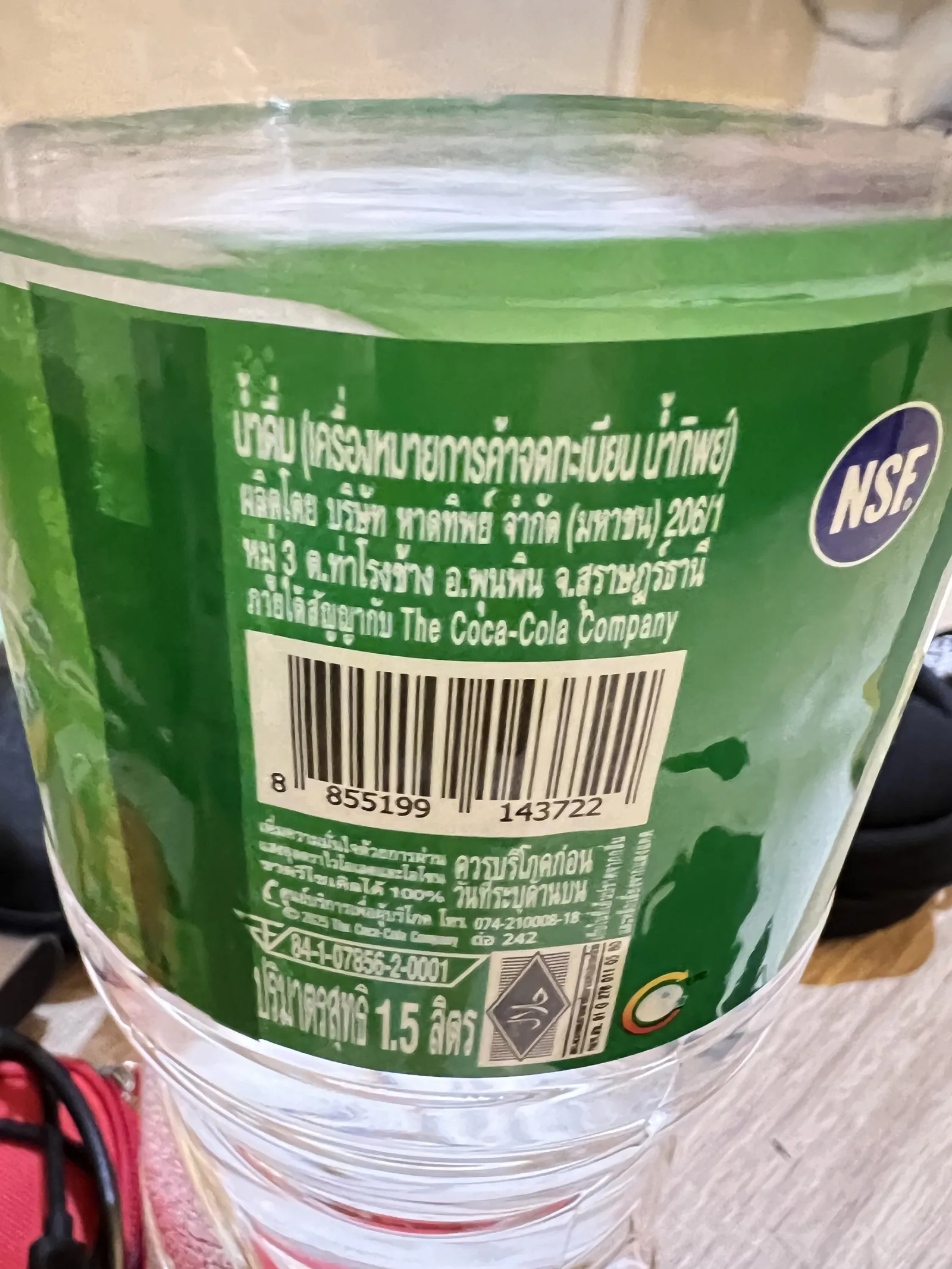
View manufacturer and barcode
Verdict: the no-frills large-bottle value. The observed 7-Eleven shelf price was ฿14, equivalent to ฿9.33 per litre. That is the lowest normalized price in this guide, but it is one physical single-bottle observation—not a stable online case listing—and should be rechecked locally.
Label evidence: barcode 8855199143722; Thai FDA number 84-1-07855-2-0001; manufactured by Haad Thip Public Company Limited for The Coca-Cola Company. The official ThaiNamthip page confirms Namthip in its Coca-Cola portfolio, while ThaiNamthip describes its bottling territory as 63 provinces excluding the south. Haad Thip serves the south and appears on this supplied bottle, so the photographed label remains the source of truth for the exact regional pack.
Government-certified carbon record: Thailand's Greenhouse Gas Management Organization lists a product carbon footprint of 172 gCO₂e per 1.5 L bottle for Haad Thip's Namthip PET line. Certificate TGO CFP FY25-027-03-0136 is shown as valid through 25 November 2027. This is a footprint record for the same brand, size, and southern bottler—not a test of mineral content or water quality, and not proof that every plant or package has the same footprint.
Independent water-quality evidence, with a regional limit: NSF's directory, current as of 1 August 2026, lists Namthip drinking water from ThaiNamthip's Khon Kaen and Pathum Thani facilities against the US FDA bottled-water standard in 21 CFR 165.110. NSF says its bottled-water certification includes annual unannounced plant inspections and testing for more than 100 microbiological, chemical, and radiological contaminants. That is meaningful brand evidence, but it does not directly certify this photographed Haad Thip southern bottle.
Historical composition evidence: peer-reviewed and Thai government measurements have reported Namthip pH and fluoride values, summarized below. They are useful brand history, but none identifies barcode 8855199143722, this Haad Thip plant, or the photographed batch.
Packaging and remaining gaps: Haad Thip says its plastic bottles are PET and 100% recyclable. That is a corporate packaging disclosure, not an independent lifecycle assessment, and it does not establish that this bottle contains recycled plastic. We did not find a current public laboratory report for barcode 8855199143722 or this batch with a full mineral panel, dissolved solids, microbes, contaminants, or microplastics. The verdict therefore remains about observed value—not a universal water-quality rating.
7-Select Drinking Water, 600 mL
Best stable catalog value. The reference pack is ฿116 for 12 bottles. Choose it when case cost matters more than brand or natural-source storytelling.
Nestlé Pure Life, 600 mL
Best process disclosure among the standard bottles. The official Thai product page specifies filtration down to 0.2 micron and NSF certification. The reference list price is ฿130 per 12.
Crystal, 600 mL
Straightforward mainstream option. It appears beside Pure Life and Singha at the same ฿130 reference list price. We found less exact process detail, so there is no evidence-based reason to rank it above them without a blind test.
Singha Drinking Water, 600 mL
Another documented filtered-water choice. Singha describes a Smart Micro Filter process. Its reference list price is also ฿130 per 12, making shelf promotion and bottle preference the practical tie-breakers.
All Spring, 600 mL
Potential mineral-water bargain, pending checkout confirmation. The category snapshot shows ฿103 per 12, but older storefront captures conflict. A 2025 three-batch study found the shortlist's highest fluoride value for the sampled AllSpring bottles, so families managing a young child's total fluoride intake should read the laboratory section and confirm the current label rather than treating “mineral” as an automatic benefit.
7-Select Mineral Water, 500 mL
Private-label mineral middle ground. At the ฿170 list reference per 12, it is materially more expensive per litre than 7-Select drinking water. The 2025 study measured the mineral brand at 0.20 mg/L fluoride and pH 7.13; no bottle size or barcode was reported.
Minéré, 500 mL
Best packaging documentation. It is natural mineral water with a ฿200 list reference per 12. The 2025 study measured the brand at 0.50 mg/L fluoride and pH 7.96, but did not identify this exact 500 mL pack. Nestlé documents an rPET program; verify the current bottle rather than assuming every size uses identical material.
Mont Fleur, 500 mL
Premium named-source option. The distributor says it comes from a deep underground source in Phop Phra, Tak. The 2025 study measured the brand at 0.09 mg/L fluoride and pH 7.48, without an exact pack match. At a ฿278 list reference per 12, it is the highest-priced exact AllOnline case in this shortlist.
Purra, 1.5 L
Large-format natural mineral option. Purra identifies a natural underground source at Phra Ngam, Sing Buri. The 2025 study measured the brand at 1.05 mg/L fluoride and pH 7.98, but did not report bottle size or barcode. We ignore the brand's detox and body-pH marketing because the cited product page does not establish those as comparative benefits.
Aura Active, 800 mL
Promising workout-size candidate; availability needs rechecking. Tipco's 2025 annual report identifies Aura Active's natural mineral-water source as Phu Kham, Wichian Buri, Phetchabun and names 7-Eleven for the 800 mL launch. The exact bottle was absent from the current online category. The 2025 laboratory paper tested “Aura,” but Tipco identifies ordinary Aura as a different Mae Rim source, so we do not transfer that result to Aura Active.
What laboratory research found across the shortlist
The strongest current brand comparison is a peer-reviewed Mahidol Dental Journal study published in April 2026. Researchers bought 41 mineral-water brands in Bangkok between April and June 2025, collected three different batches of each brand, and measured fluoride with an ion-selective electrode plus TISAB II and pH with a calibrated digital meter. Six names overlap this guide. The paper found no significant within-brand batch differences, but it did not publish bottle sizes, barcodes, production plants, or full mineral panels.
Mineral waters: 2025 samples, published 2026
| Guide product | Fluoride, mg/L | pH | What the result can—and cannot—represent |
|---|---|---|---|
| All Spring | 1.69 ± 0.012 | 8.46 ± 0.05 | AllSpring brand, three batches. The paper does not identify the guide's 600 mL barcode or plant. |
| Purra | 1.05 ± 0.000 | 7.98 ± 0.02 | Purra brand, three batches; no exact match to the guide's 1.5 L pack. |
| Minéré | 0.50 ± 0.003 | 7.96 ± 0.03 | Minere brand, three batches; no exact match to the guide's 500 mL pack. |
| Aura Active | — | — | The study's ordinary Aura sample was 0.35 ± 0.001 mg/L and pH 7.39 ± 0.03, but Tipco says Aura Active uses a different Phetchabun source. Not transferred. |
| 7-Select mineral | 0.20 ± 0.005 | 7.13 ± 0.05 | 7-Select Mineral Water, three batches; bottle size and barcode not reported. |
| Mont Fleur | 0.09 ± 0.001 | 7.48 ± 0.06 | Mont Fleur brand, three batches; no exact match to the guide's 500 mL pack. |
pH is included because the researchers measured it, not because a higher number wins. A pH result does not establish contaminant safety, total mineral content, or better workout hydration, so it is not scored as a health benefit.
Drinking waters: historical 2016 retail samples
The best brand-by-brand comparison for the five ordinary drinking waters is older. In a 2016 peer-reviewed study, researchers bought three bottles with different batch numbers and bottling dates for each brand in Bangkok, measured each fluoride sample twice with an ion-selective electrode, and measured pH by meter.
| Guide product | Fluoride, mg/L | pH | Evidence boundary |
|---|---|---|---|
| Nestlé Pure Life | 0.47 ± 0.01 | 7.63 | Historical brand sample; no bottle size, barcode, plant, or exact guide-pack match. |
| Singha drinking water | 0.43 ± 0.00 | 8.05 | Historical brand sample. A Thai government survey later found plant-level variation, so this is not a universal Singha value. |
| Namthip | 0.04 ± 0.00 | 6.61 | Not the photographed Haad Thip 1.5 L pack. A separate government survey identified a Lak Si source at about 0.08 mg/L. |
| 7-Select drinking water | 0.02 ± 0.00 | 6.79 | Historical brand sample; no exact 600 mL barcode or production source reported. |
| Crystal | 0.02 ± 0.00 | 6.69 | Historical brand sample; no exact 600 mL barcode or production source reported. |
Why plant identity matters: a 2016 Thai Department of Health convenience-store survey reported Singha fluoride summaries ranging from 0.25 to 0.68 mg/L across named production sources, Pure Life at 0.50 mg/L, 7-Select drinking water at 0.08 mg/L, Namthip at 0.08 mg/L, and Crystal at 0.12 mg/L. Those are useful cross-checks, not contradictions: source water, plant, treatment, season, and batch can change a brand-level result.
What we still cannot responsibly put in a brand table
A 2015 peer-reviewed Thai study measured pH, TDS, hardness, sodium, potassium, chloride, bicarbonate, magnesium, calcium, phosphate, and iron in local bottled waters. It is exactly the kind of full composition panel we wanted—but the published brands are anonymized as “local bottled mineral water #1–#3,” so none can be assigned to Aura, Purra, Minéré, Mont Fleur, or another product here. Unreferenced online charts that repeat calcium and magnesium numbers without an identifiable bottle, laboratory report, or method were also excluded.
A 2020 peer-reviewed Thai study found an average 140 ± 19 microplastic particles per litre across ten single-use PET-bottled waters, compared with 52 ± 4 in glass-bottled water, using Nile Red fluorescence, microscopy, FTIR, and Raman methods. The paper does not disclose a usable brand-to-result mapping, so it cannot rank these eleven products or establish a value for any exact bottle.
The likely social-media lead: a January 2023 Specialty Coffee Institute of Thailand post lists several familiar brands, including Namthip at TDS 2 ppm and pH 6.78. It may be the chart remembered from Instagram, but the page gives no bottle sizes, plants, batches, instrument, calibration, repeats, or underlying report. TDS is a total—not a list of which minerals are present. We preserve it only as an unverified informal lead and do not use it in a verdict.
Bottom line: public research now gives a useful fluoride-and-pH comparison for ten of the eleven brand names, with Aura Active deliberately left unmatched. It still does not provide a current, exact-pack calcium, magnesium, sodium, bicarbonate, hardness, contaminant, or microplastic table. The clean next step is accredited testing of the exact barcodes and production sources.
Plain water, mineral water, or electrolytes after training?
For most fitness sessions lasting less than roughly 60–90 minutes in normal conditions, plain water is usually enough. The American College of Sports Medicine notes that ordinary fitness exercisers in that range are unlikely to deplete electrolytes. Heat, high sweat rates, repeated sessions, and longer endurance work change the decision.
Natural mineral water contains naturally occurring minerals, but that label alone does not tell you whether a bottle delivers enough sodium for meaningful sweat replacement. If sodium concentration is the real goal, use our 7-Eleven electrolyte guide, which compares declared sodium and mixing volumes rather than assuming every “mineral” product is a sports drink.
Also avoid overdrinking. More water is not always better during prolonged exercise; hydration should reflect thirst, conditions, duration, body size, and sweat losses.
Limitations, source notes, and what to photograph next
- No taste claims: we did not open or blind-taste the eleven products.
- No exact-pack laboratory claims: MyFitMate did not commission testing of these eleven bottles. The published studies identify brands but usually omit size, barcode, plant, and batch details; every result is labelled accordingly.
- Online is not in-store: AllOnline assortment, promotions, pack sizes, and prices can differ by branch and date.
- Not a sales ranking: this is an editorial shortlist. Neither AllOnline ordering nor this article establishes national market rank.
- Exact labels still matter: formulas, water sources, bottlers, package materials, and barcodes can change by size, plant, region, or batch.
- Marketing was not scored: alkaline, detox, beauty, “cell balance,” taste awards, and similar claims were not treated as fitness outcomes.
For the next revision, photograph the front, source/mineral panel, manufacturer/FDA panel, barcode, and shelf price for each exact bottle. That would allow a clean label-level comparison and a separate blind taste test without mixing catalog claims with physical evidence.
Primary sources
- AllOnline drinking-water category, mineral-water category, and 7-Select brand page; reviewed 19 August 2026.
- ThaiNamthip Namthip product page, ThaiNamthip bottling-territory note, Coca-Cola Namthip, and Haad Thip; the supplied bottle label controls where it is more specific.
- Thailand Greenhouse Gas Management Organization: Namthip 1.5 L product carbon footprint; certificate TGO CFP FY25-027-03-0136, shown as valid through 25 November 2027.
- NSF Namthip bottled-water listing and NSF certification-method explanation. The directory applies to ThaiNamthip's Khon Kaen and Pathum Thani plants, not the photographed Haad Thip bottle.
- Prutthithaworn and Rirattanapong, Mahidol Dental Journal (2026): fluoride and pH in 41 Bangkok mineral-water brands. The study purchased three batches per brand in April–June 2025.
- Peer-reviewed 2013 bottled-water pH study; peer-reviewed 2016 bottled-water fluoride and pH study; and the Thai Department of Health's 2016 convenience-store fluoride survey. None reports exact barcodes for this guide.
- Lekskulchai, ScienceAsia (2015): minerals in drinking water available in three Thai provinces. The bottled-water brands are anonymized, so its full mineral results are not assigned to products here.
- Kankanige and Babel, Science of the Total Environment (2020): microplastics in Thai PET-bottled water. Results are retained only at the aggregate packaging level because a usable brand mapping was not published.
- WHO fluoride chemical fact sheet: 1.5 mg/L guideline value, with local adaptation for factors such as climate and water consumption.
- Specialty Coffee Institute of Thailand pH/TDS post, 6 January 2023. It is retained only as an informal lead because no measurement method or bottle identity is disclosed.
- The Namthip 1.5 L price is a user-supplied 7-Eleven shelf observation from 19 August 2026, independently consistent with the Big C single-bottle listing. It is not presented as an official nationwide 7-Eleven price.
- Pure Life 600 mL, Singha drinking water, Minéré, Mont Fleur, Purra, and Tipco's 2025 annual report. Tipco's report distinguishes ordinary Aura's Mae Rim source from Aura Active's Phu Kham source.
- WHO: Calcium and magnesium in drinking-water and ACSM: Hydration and electrolytes.
Research cutoff: 19 August 2026. Baht-per-litre figures are calculated from the stated purchase price and total volume; case and single-bottle formats are identified separately. Product names are rendered in English for readability; Thai labels and retailer pages remain the reference.