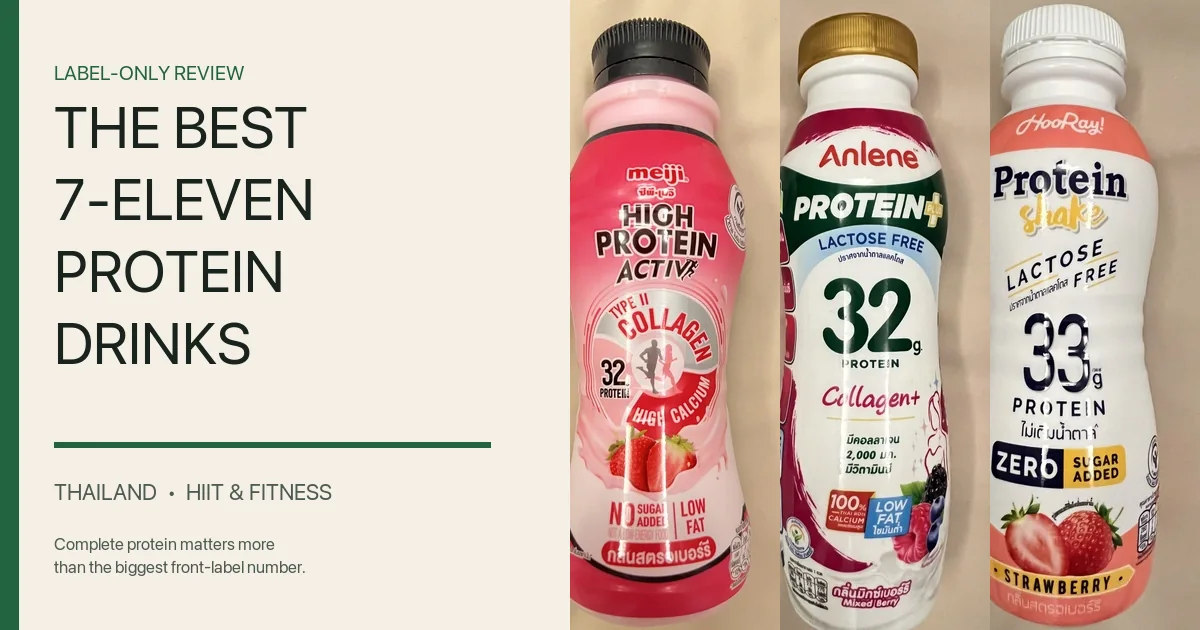
Five ranked bottles, plus a separate laboratory cross-check
Thai 7-Eleven stores now carry several bottles promising 27 to 33 grams of protein, but the biggest number on the front is not always the most useful one. Protein source, collagen content, calories, sugar, and amino-acid transparency all affect whether a drink is a strong recovery choice or simply a convenient snack.
We compared five ready-to-drink bottles in the context of HIIT and fitness training in Thailand. The review uses photographed front, nutrition, ingredient, and barcode labels. Taste, texture, and price were not assessed.
The new laboratory section covers eight additional SKUs. It checks only measured protein-equivalent against the front-label claim; it does not establish taste, calories, sugar, amino-acid quality, retail availability, or whether the protein is complete. The tested Meiji chocolate and Hooray banana bottles are not the same variants as the ranked Meiji strawberry and Hooray strawberry bottles.
How collagen is treated
Useful complete protein outranks the raw headline number. Complete dairy protein and complementary milk, casein, and plant-protein blends count toward muscle-recovery protein. Collagen does not have an equivalent indispensable-amino-acid profile, so it is not counted as interchangeable with complete protein in this score.
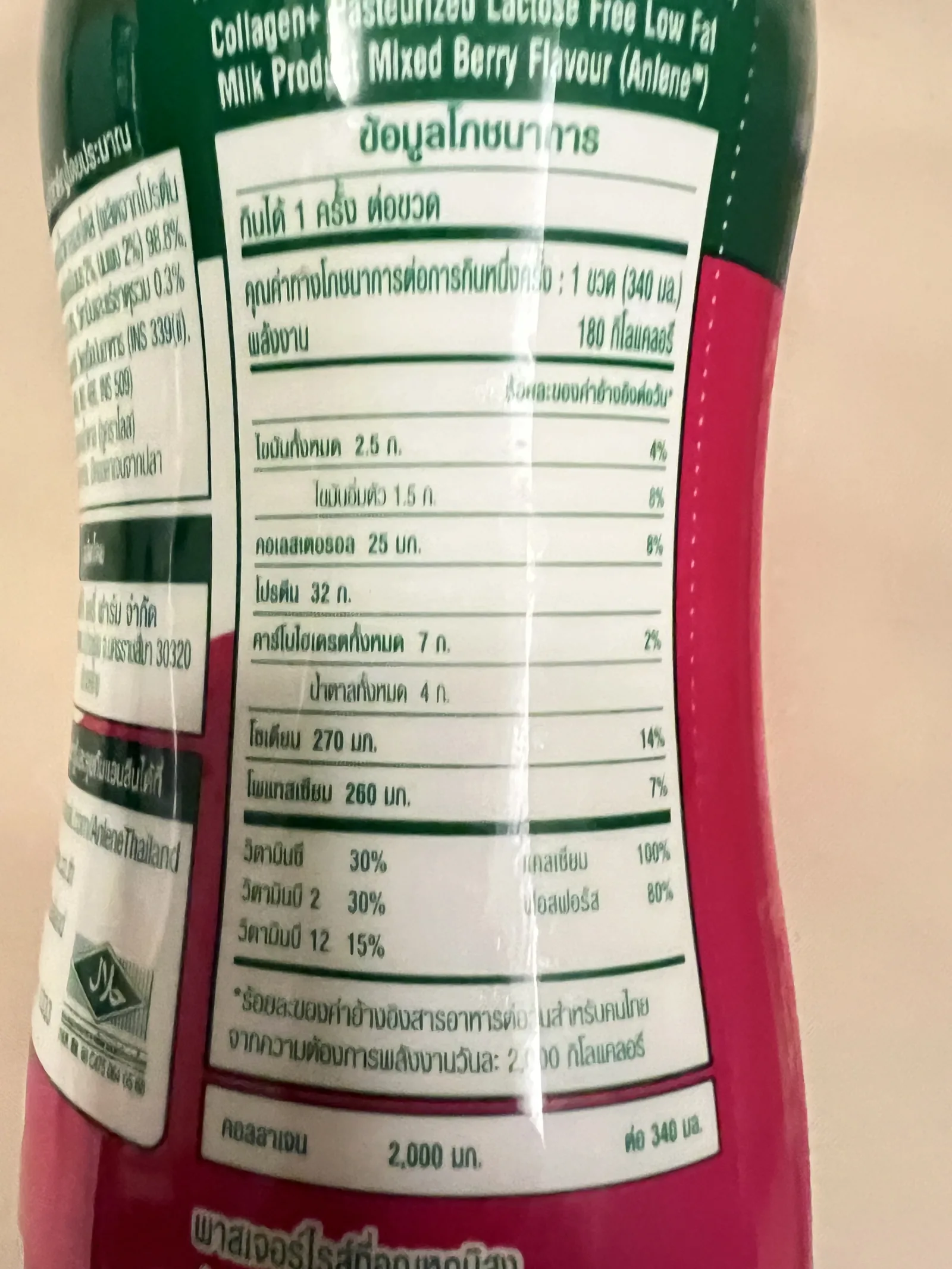
Meiji declares Type II collagen at 0.14%, approximately 0.49 g per 350 mL bottle. Anlene declares 2 g collagen. Neither photographed label makes it completely clear whether that collagen is included within the headline total-protein figure, so both amounts are subtracted conservatively when estimating useful complete protein. This is a ranking rule for recovery—not a claim that collagen cannot have other purposes.
Transparent scorecard
Each bottle is scored out of 100 using the same six criteria. No taste score is included.
| Criterion | Points | What earns a stronger score |
|---|---|---|
| Useful complete-protein dose | 30 | More protein attributable to complete dairy sources or a complete/complementary blend, after conservatively removing declared collagen. |
| Useful protein density | 25 | More useful complete protein per 100 kcal, rather than the largest bottle-front number alone. |
| Recovery suitability | 20 | A complete source and, where disclosed, useful amino-acid evidence such as leucine and BCAAs. |
| Calorie, sugar, and fat balance | 15 | A balanced energy load for broad fitness use; extra carbohydrate can still suit demanding post-workout recovery. |
| Label transparency | 5 | Clear protein sources, nutrition, ingredients, and amino-acid or collagen disclosure. |
| Ready-to-drink convenience | 5 | A complete single-bottle serving with no mixing required. |
| Total | 100 | Final scores are comparative judgments within these five photographed products. |
Final ranking
| Rank | Product | Score | Main verdict |
|---|---|---|---|
| 1 | Meiji High Protein Active | 94/100 | Best overall balance of useful complete protein, calories, sugar, fat, and sodium. |
| 2 | Anlene Protein+ Collagen+ | 90/100 | Best calorie-cutting option, with a conservative collagen deduction. |
| 3 | Hooray! Protein Shake | 86/100 | Strongest explicit amino-acid evidence and an excellent hard-training option. |
| 4 | Sunshine Dairy High Protein | 85/100 | Solid complete dairy protein, but with more calories and fat. |
| 5 | Yendrink Protein Blend | 75/100 | Legitimate convenient protein, but the lowest dose plus the most sugar and sodium. |
Nutrition comparison
All figures are per bottle. “Useful complete protein” is an estimate only where a declared collagen amount has been conservatively removed.
| Product | Size | kcal | Total protein | Useful complete protein | Total / useful protein per 100 kcal | Carb / sugar | Fat / saturated | Sodium |
|---|---|---|---|---|---|---|---|---|
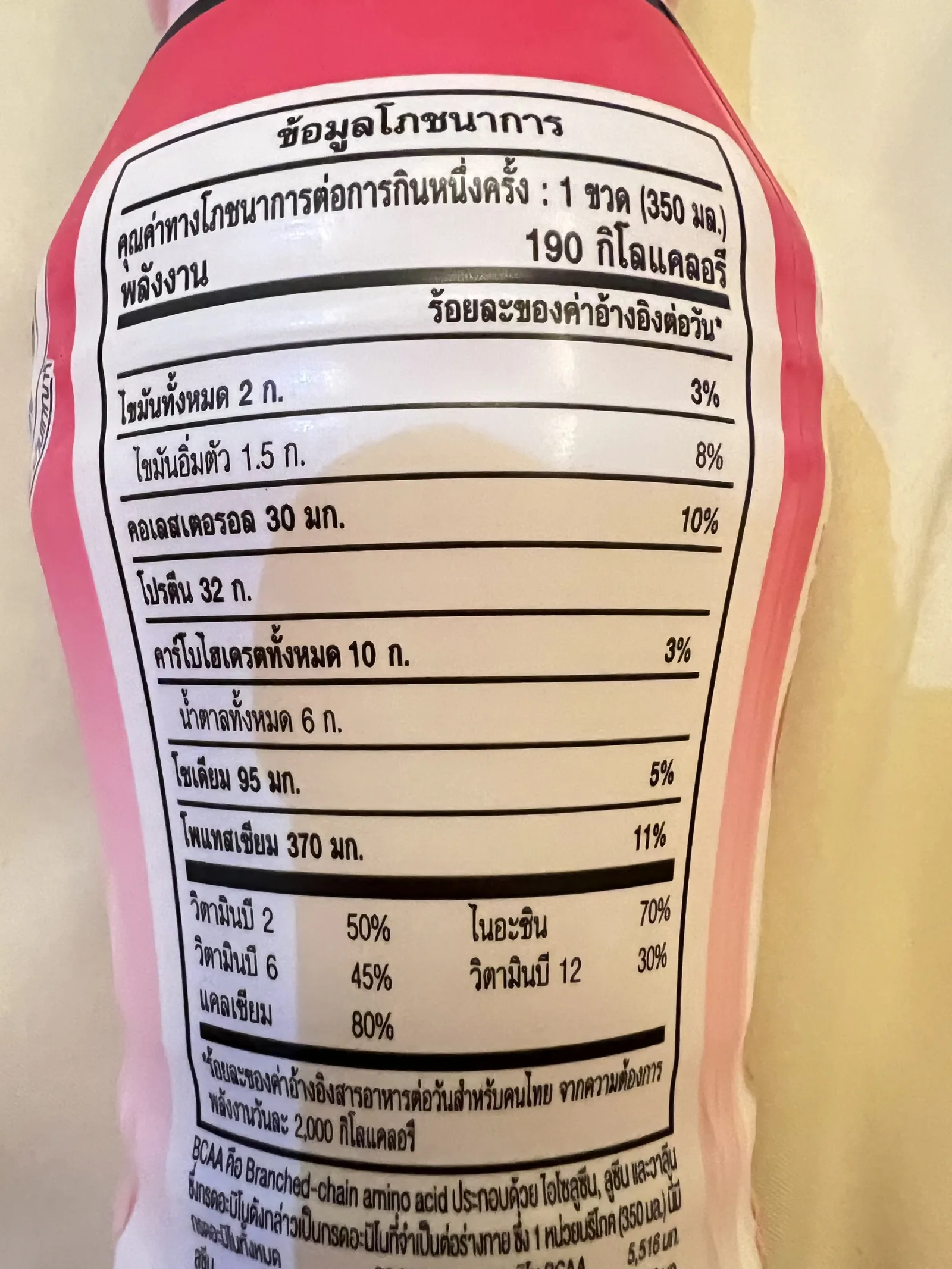
| Meiji High Protein Active | 350 mL | 190 | 32 g | ~31.5 g | 16.8 / ~16.6 g | 10 / 6 g | 2 / 1.5 g | 95 mg |
| Anlene Protein+ Collagen+ | 340 mL | 180 | 32 g | ~30 g | 17.8 / ~16.7 g | 7 / 4 g | 2.5 / 1.5 g | 270 mg |
| Hooray! Protein Shake | 340 mL | 260 | 33 g | 33 g | 12.7 / 12.7 g | 23 / 6 g | 3.5 / 2.5 g | 160 mg |
| Sunshine Dairy High Protein | 340 mL | 250 | 33 g | 33 g | 13.2 / 13.2 g | 16 / 7 g | 5 / 3 g | 120 mg |
| Yendrink Protein Blend | 300 mL | 200 | 27 g | 27 g | 13.5 / 13.5 g | 15 / 14 g | 4 / 3 g | 490 mg |
Fiber is not declared on any of the five photographed nutrition panels. “Useful” protein values for Meiji and Anlene are conservative estimates, not laboratory measurements.
What to choose by goal
Approximately 31.5 g useful complete protein for 190 kcal, with the lowest sodium and only 2 g fat.
The lowest calorie and sugar totals, while still providing about 30 g useful complete protein after the collagen deduction.
The label confirms 5.92 g BCAAs, including 2.94 g leucine, and its extra carbohydrate can be useful after demanding work.
A straightforward 33 g complete dairy-protein bottle when the additional calories and fat fit the day.
Its 490 mg sodium may fit a high-sweat recovery context, but sugar and sodium make it a weaker routine all-purpose choice.
Choose Meiji for the stronger all-round profile or Anlene when minimizing calories is the priority.
Protein drinks are convenient, but they are not mandatory after every class. A normal meal with sufficient complete protein can serve the same recovery goal, and hydration still needs to match the session and the athlete.
Five product verdicts
Products appear in the requested final ranking. Open any photo to inspect the larger, optimized label image.
Rank #1 · 94/100 · Best overall
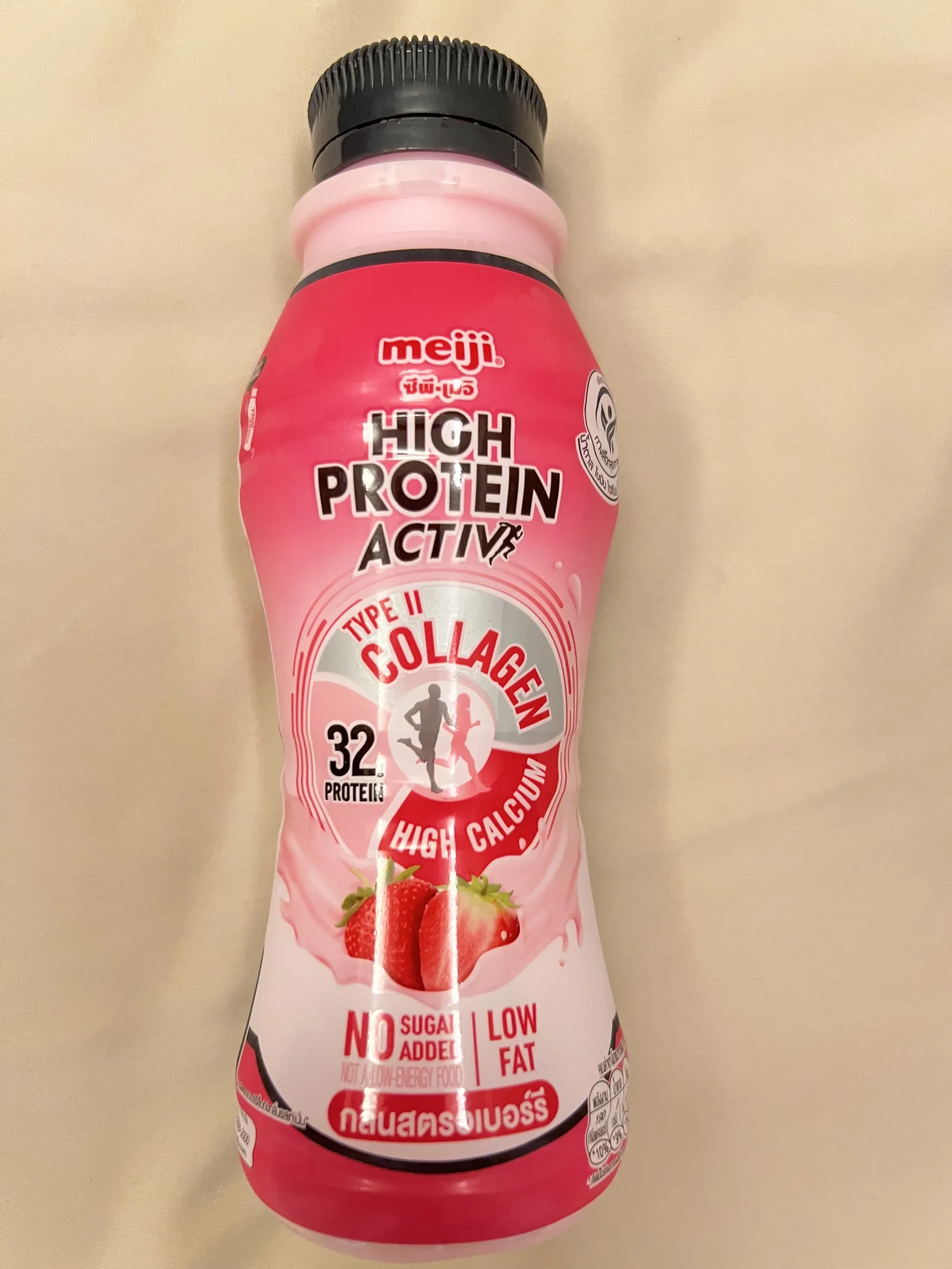
Meiji High Protein Active Type II Collagen Strawberry
| Bottle | 350 mL; 190 kcal |
|---|---|
| Protein | 32 g total; ~31.5 g useful complete protein |
| Carbohydrate / sugar | 10 g / 6 g |
| Fat / saturated fat | 2 g / 1.5 g |
| Sodium | 95 mg |
Assessment: The strongest all-round balance. Milk protein concentrate is the primary protein source, giving this bottle approximately 31.5 g useful complete dairy protein after conservatively removing the declared collagen fraction.
Collagen note: Type II collagen is listed at 0.14%, approximately 0.49 g in 350 mL. The label does not make it completely clear whether that amount is included in the 32 g total.
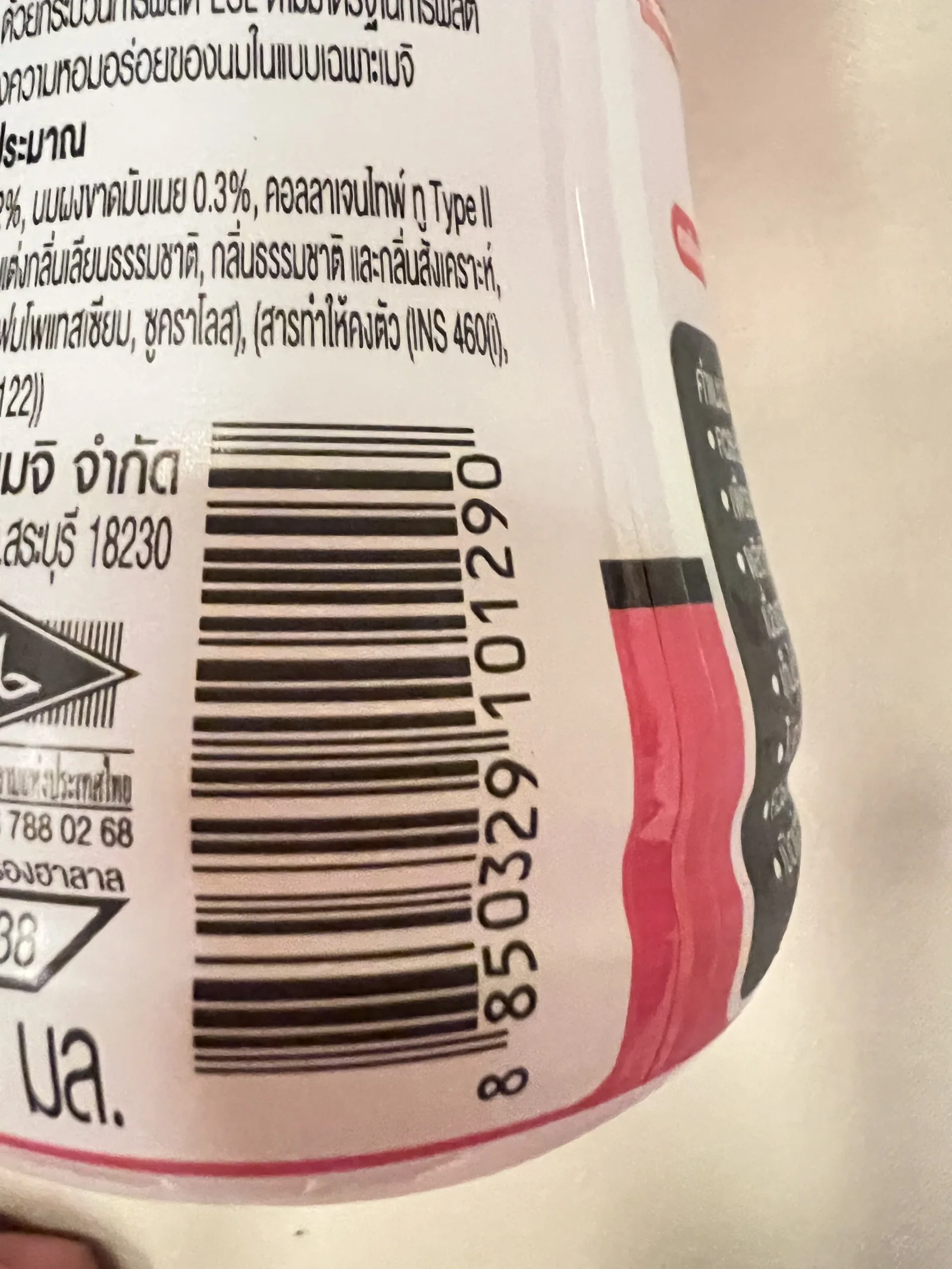
Other label details: Sweeteners include acesulfame-K and sucralose. The label also identifies stabilizers INS 460(i), 471, 466, and 407, plus colour INS 122. Contains milk.
Verdict: Best overall for post-workout recovery, general daily protein, and calorie-conscious use.
Rank #2 · 90/100 · Best for cutting
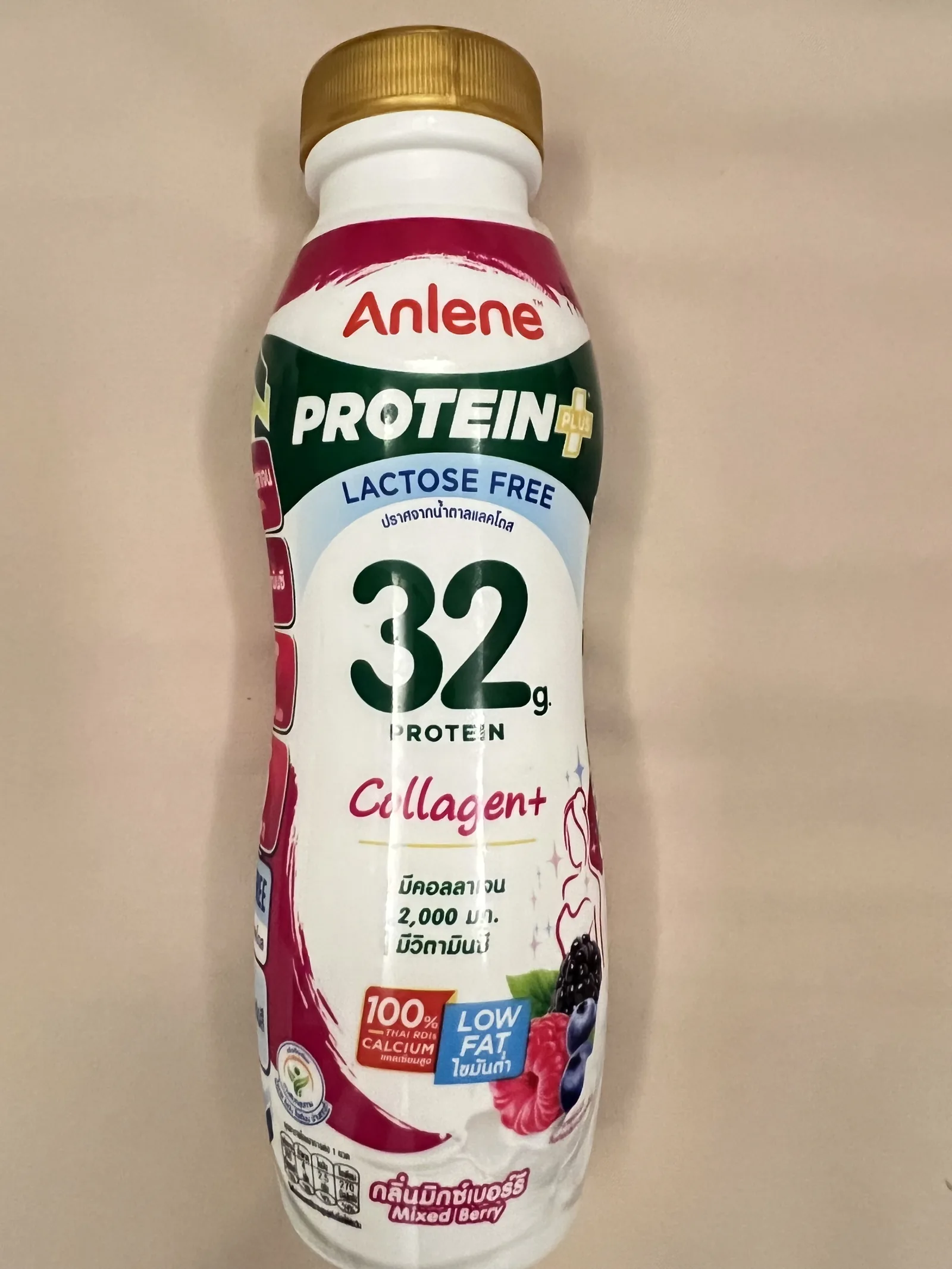
Anlene Protein+ Collagen+ Mixed Berry
| Bottle | 340 mL; 180 kcal |
|---|---|
| Protein | 32 g total; ~30 g useful complete protein |
| Carbohydrate / sugar | 7 g / 4 g |
| Fat / saturated fat | 2.5 g / 1.5 g |
| Sodium | 270 mg |
Assessment: The best cutting-oriented option. It has the highest headline protein density at 17.8 g per 100 kcal; after subtracting 2 g declared collagen, the conservative useful-protein estimate is still about 16.7 g per 100 kcal.
Transparency tradeoff: The supplied photographs do not capture a complete ingredient or additive statement, so the precise milk-protein fractions and sweeteners remain unverified. Sodium is moderately high at 270 mg. Contains milk.
Verdict: Best for cutting and weight control, narrowly behind Meiji because of the larger collagen fraction and weaker ingredient transparency.
Rank #3 · 86/100 · Best amino-acid disclosure
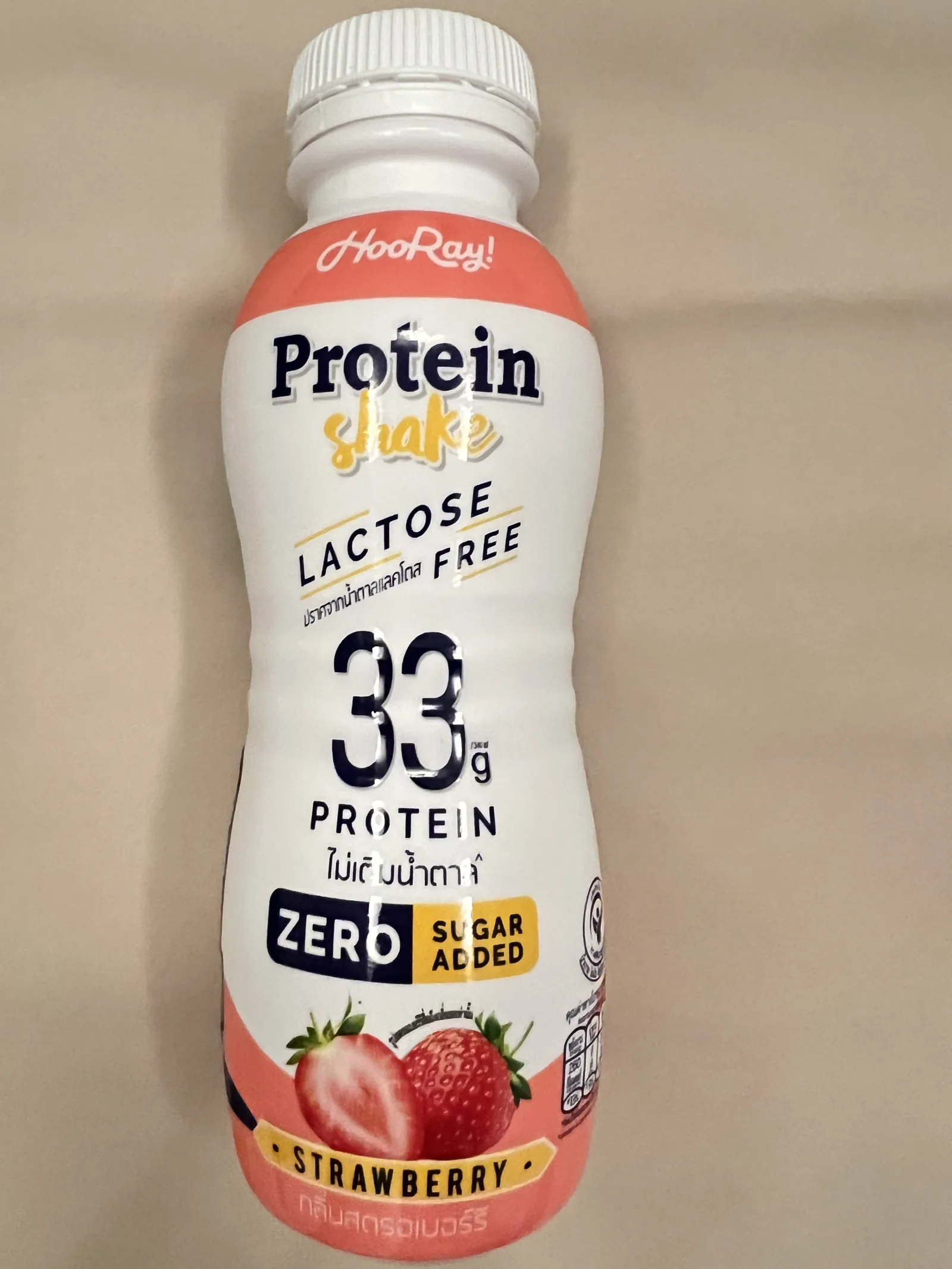
Hooray! Protein Shake Lactose Free Strawberry
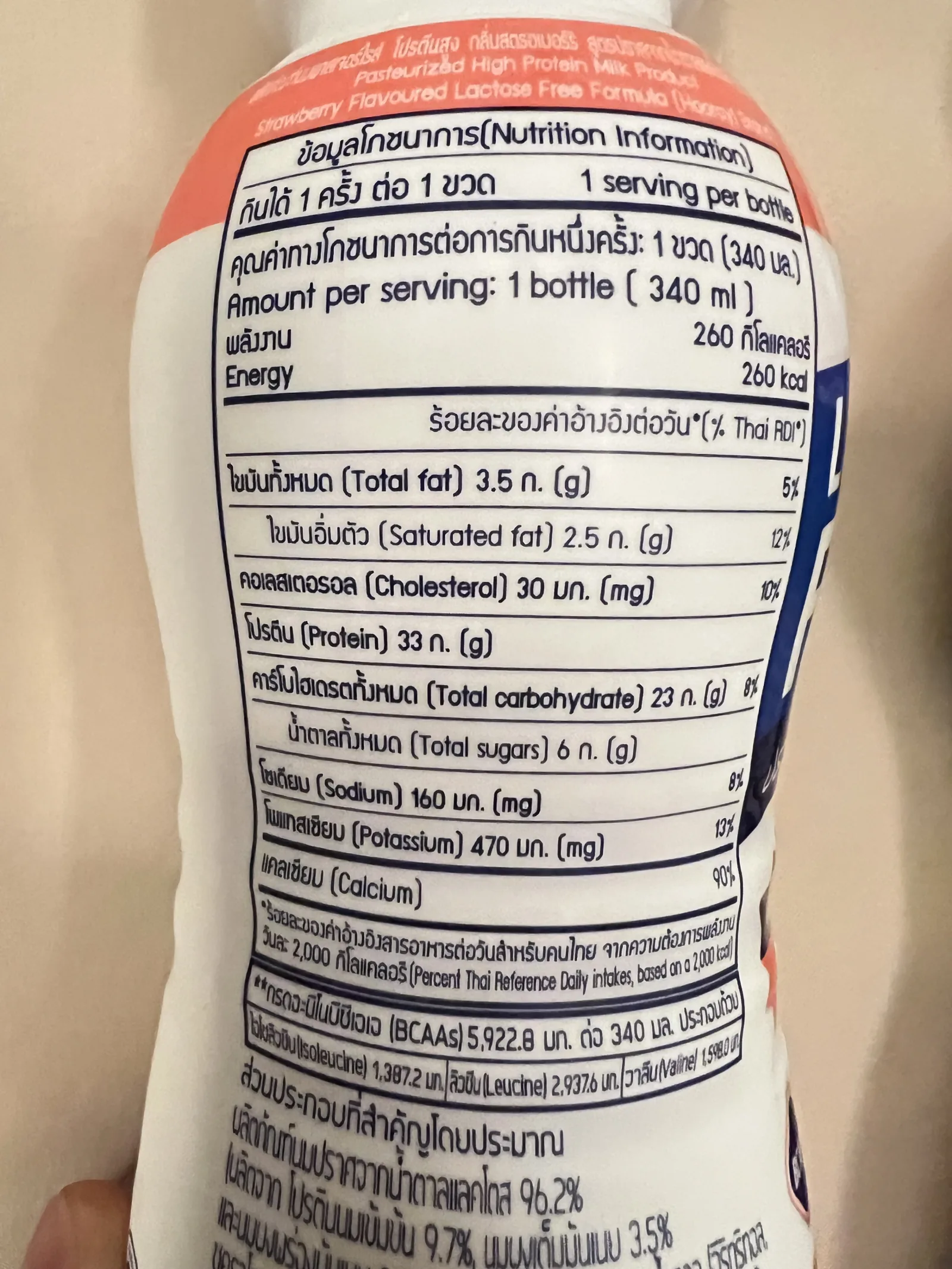
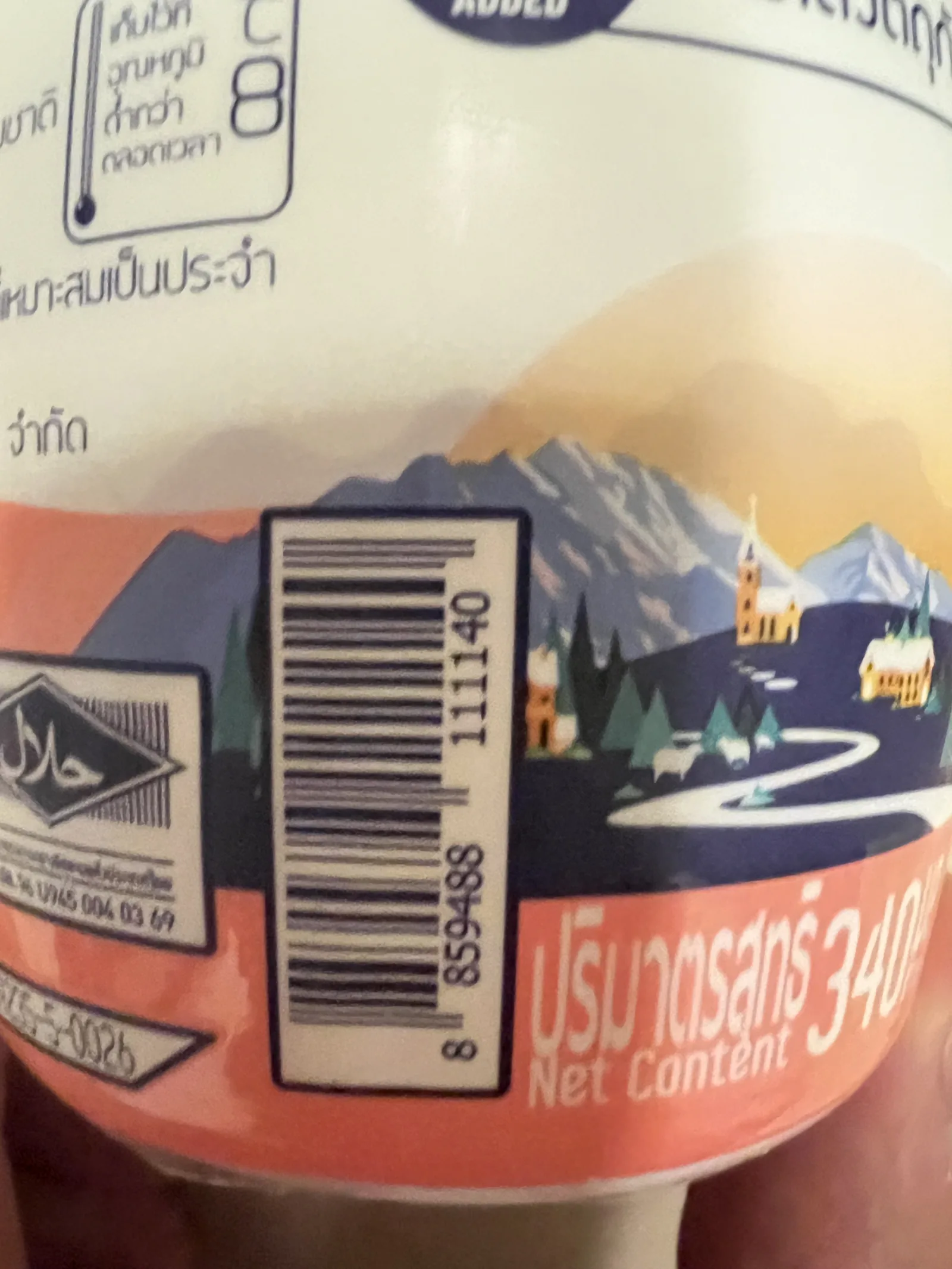
| Bottle | 340 mL; 260 kcal |
|---|---|
| Protein | 33 g useful complete dairy protein |
| BCAAs | 5.92 g, including 2.94 g leucine |
| Carbohydrate / sugar | 23 g / 6 g |
| Fat / saturated fat | 3.5 g / 2.5 g |
| Sodium / potassium | 160 mg / 470 mg |
Assessment: The strongest explicit recovery evidence. The label discloses 5.92 g BCAAs: 2.94 g leucine, 1.39 g isoleucine, and 1.60 g valine. No collagen is declared, so the full 33 g can reasonably be treated as complete dairy protein.
Energy tradeoff: Its 23 g carbohydrate can be useful after demanding HIIT, but 260 kcal gives it the lowest protein density among the 33 g dairy options. “Zero sugar added” does not mean sugar-free; the nutrition panel still declares 6 g total sugar. Contains milk.
Formula caution: The current ingredient photograph is incomplete. A legacy or mixed-version Open Food Facts entry appears to combine an older 30 g/300 mL product with this current 33 g/340 mL bottle, so its listed sweeteners and additives are not presented here as a confirmed current formulation.
Verdict: Excellent after hard training and the most transparent amino-acid profile, but only average for cutting.
Rank #4 · 85/100 · Complete dairy protein
Sunshine Dairy High Protein Lactose Free Milk Strawberry
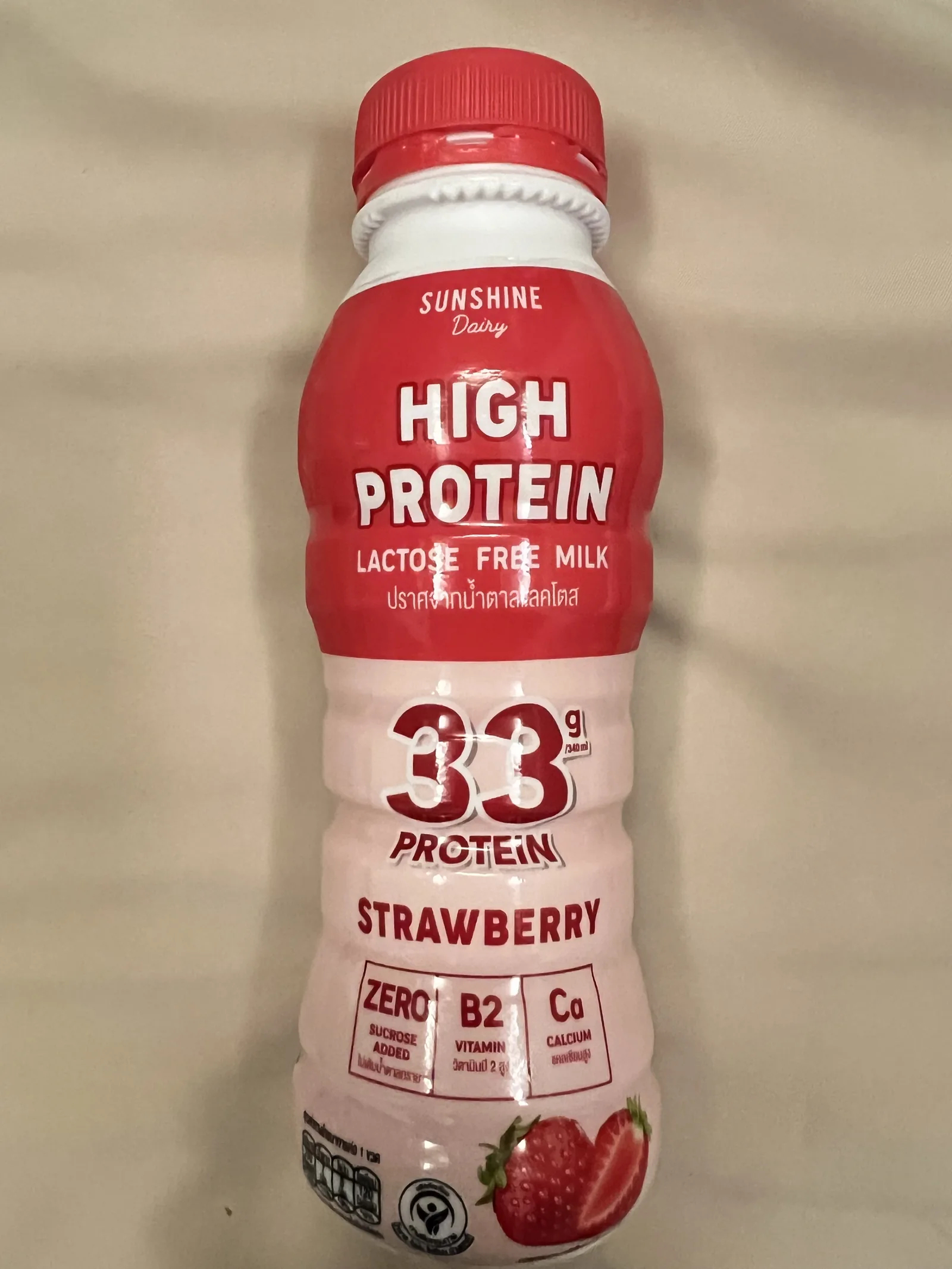
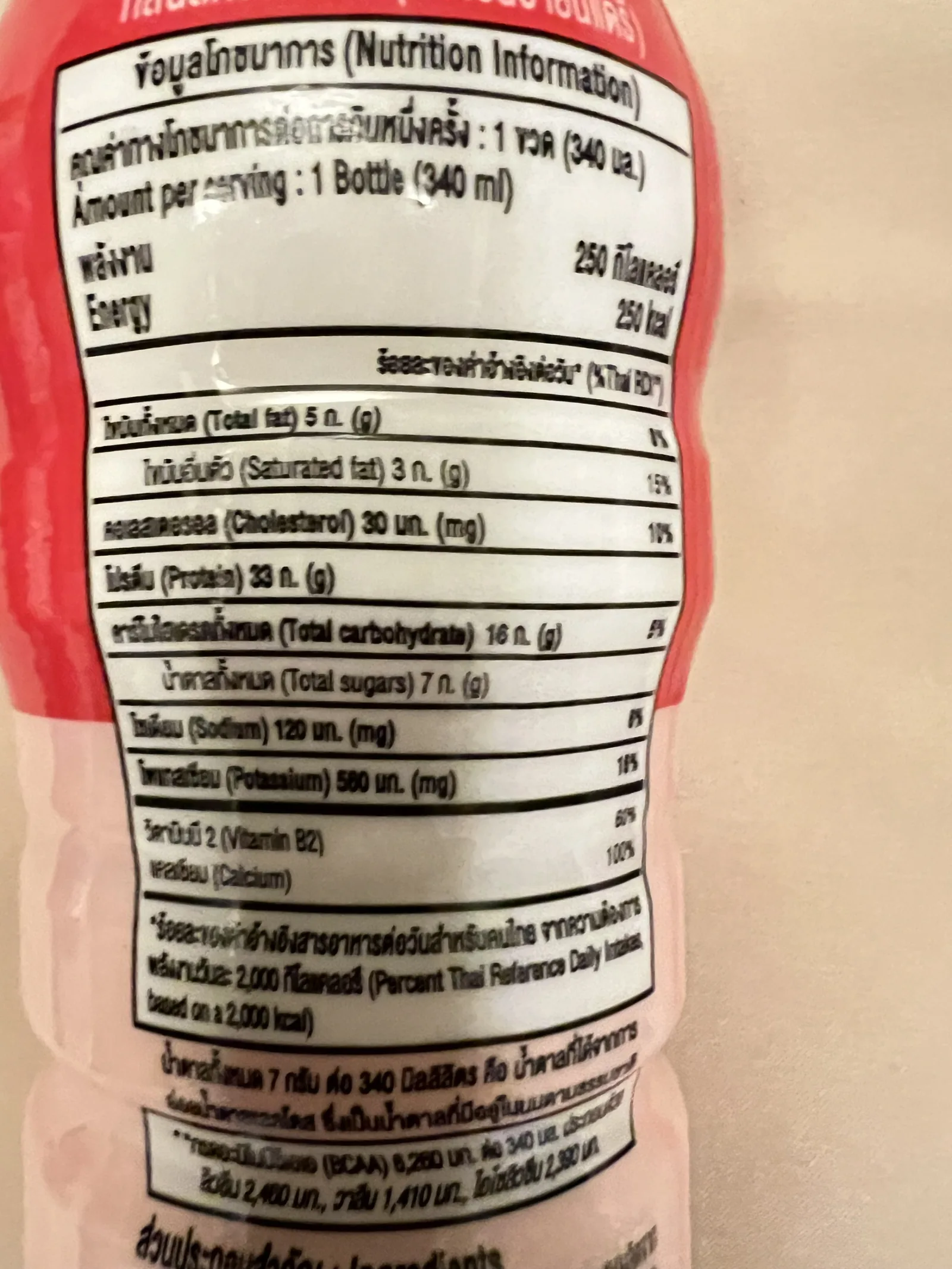
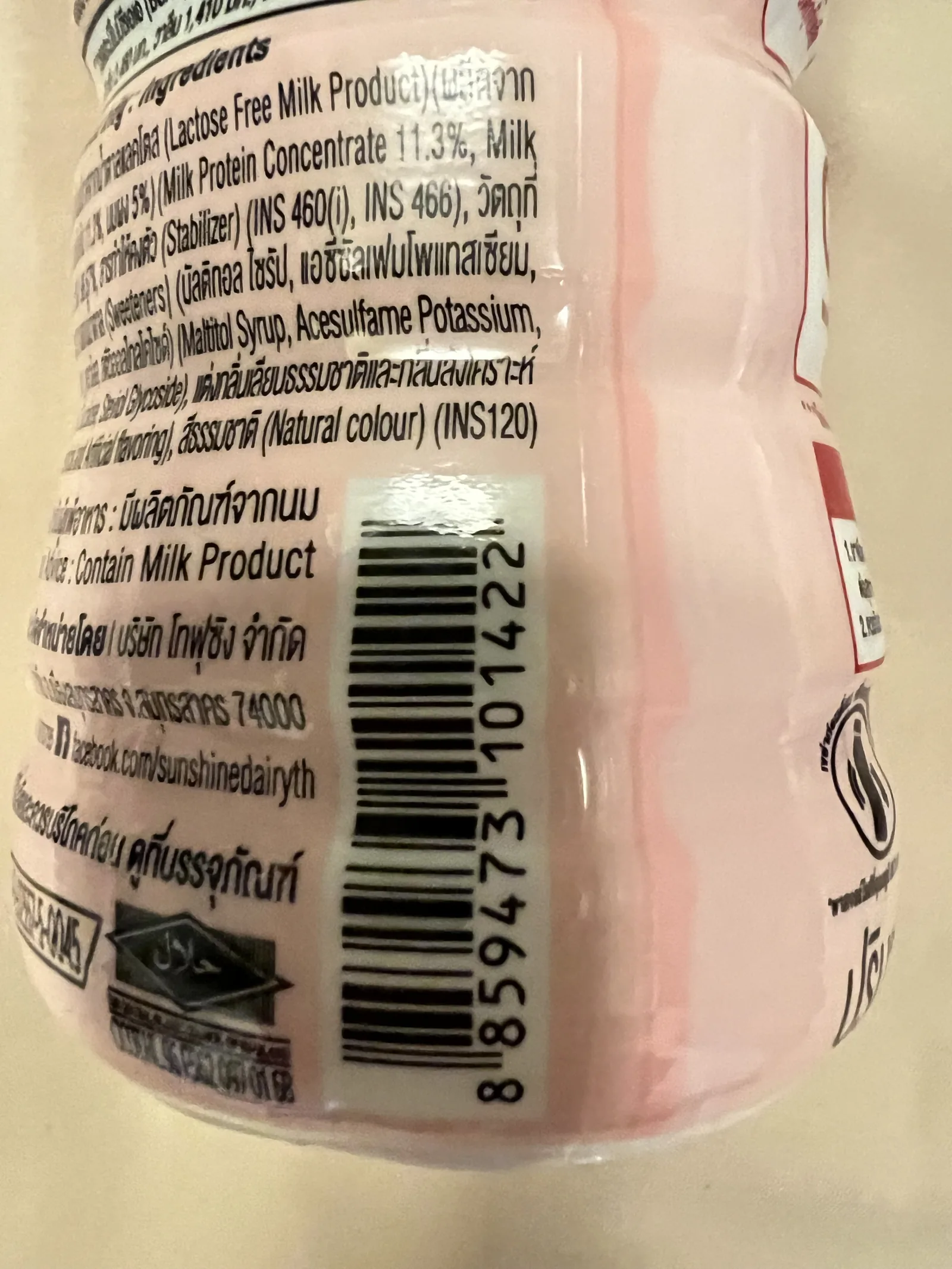
| Bottle | 340 mL; 250 kcal |
|---|---|
| Protein | 33 g useful complete dairy protein |
| Carbohydrate / sugar | 16 g / 7 g |
| Fat / saturated fat | 5 g / 3 g |
| Sodium / potassium | 120 mg / 580 mg |
Assessment: A straightforward 33 g complete dairy-protein option with no collagen declared. Protein density is 13.2 g per 100 kcal, but the 250 kcal and 5 g fat place it just behind Hooray overall.
Other label details: The ingredient statement identifies a milk base and milk protein concentrate. It also lists maltitol syrup, acesulfame-K, erythritol, sucralose, steviol glycosides, stabilizers INS 460(i) and 466, and colour INS 120. Contains milk.
Verdict: Good for recovery and daily convenience, particularly when the higher calorie and fat load fits the rest of the diet.
Rank #5 · 75/100 · Convenient blended protein
Yendrink Protein Blend Olympus Taro Milk Tea
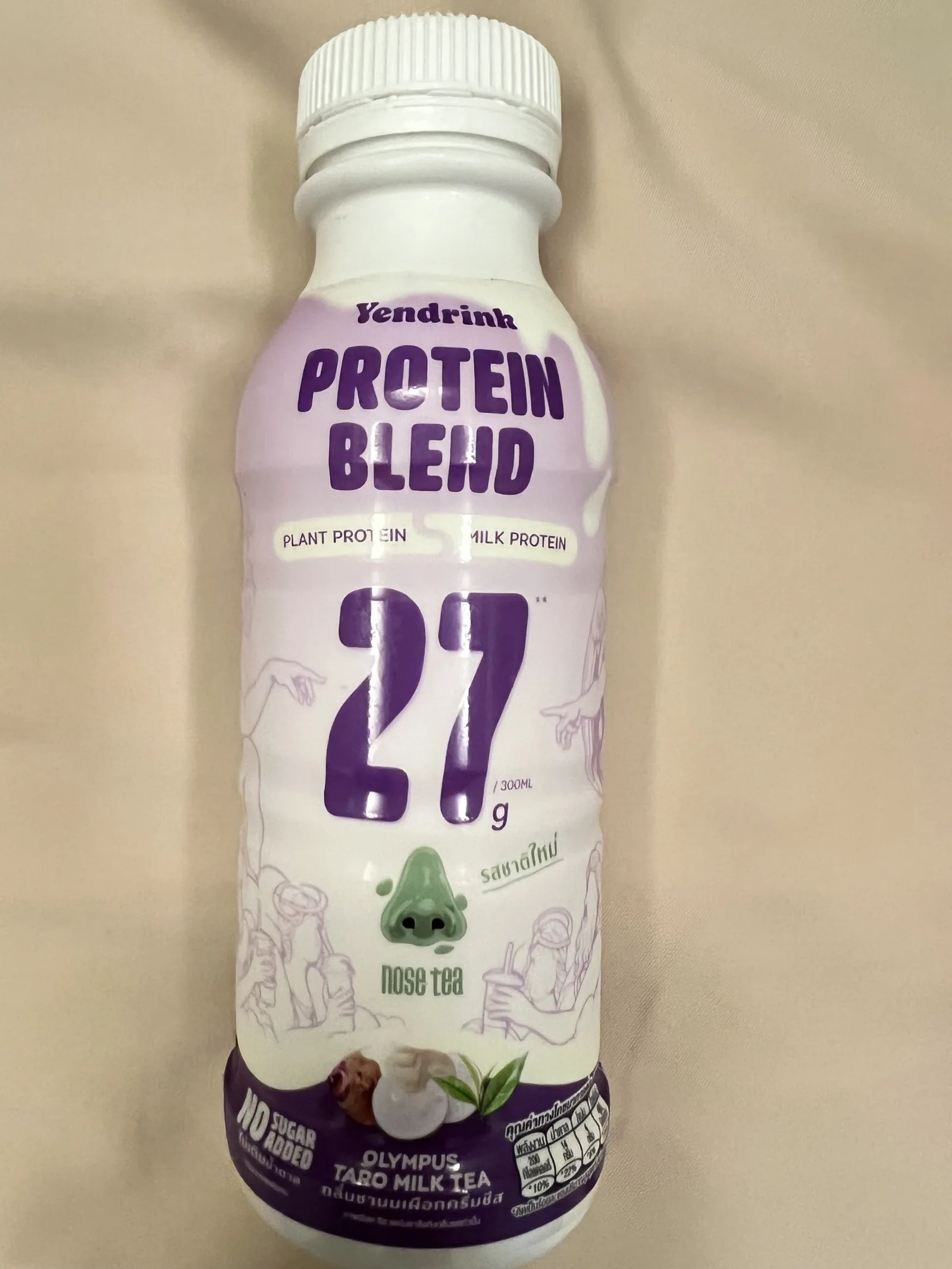
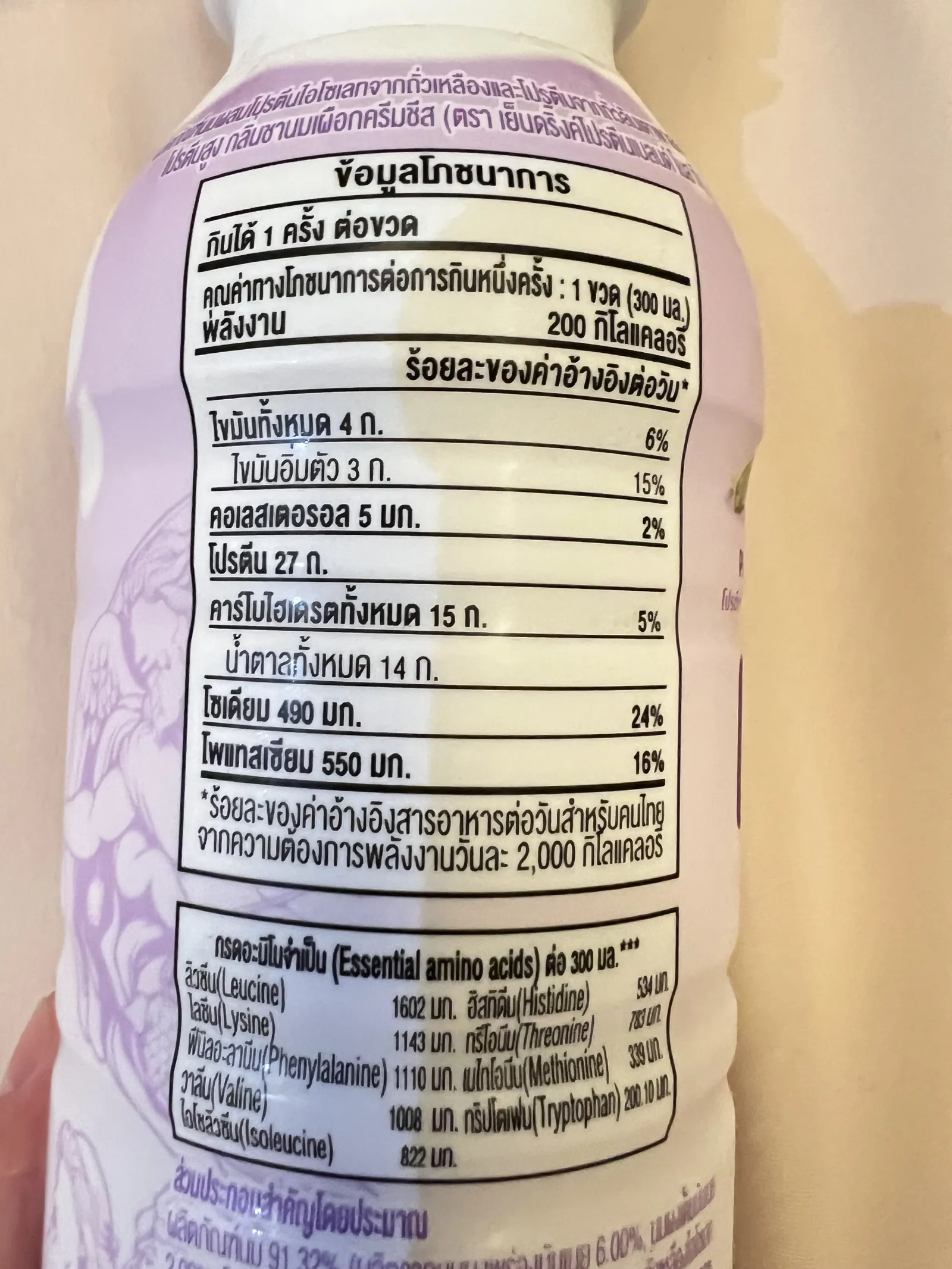
| Bottle | 300 mL; 200 kcal |
|---|---|
| Protein | 27 g from a milk, casein, and plant-protein blend |
| Carbohydrate / sugar | 15 g / 14 g |
| Fat / saturated fat | 4 g / 3 g |
| Sodium / potassium | 490 mg / 550 mg |
Assessment: The milk/casein and plant-protein blend supplies a complete or complementary amino-acid profile, but this bottle has the lowest protein dose in the group.
Balance tradeoff: Its 490 mg sodium may be useful after exceptionally sweaty training in Thailand, but it is high for routine daily use. The bottle also has the most sugar at 14 g.
Transparency tradeoff: The complete ingredient and additive statement was not captured, and the Open Food Facts record is sparse. Contains milk and soy.
Verdict: Still a legitimate convenient protein drink, but the sugar, sodium, and lower protein dose make it the weakest all-purpose choice here.
What eight Chulalongkorn laboratory reports add
The supplied documents are reports C 0661/26 through C 0668/26 from the Food Research and Testing Laboratory, Faculty of Science, Chulalongkorn University. They are dated 6 July 2026; each says the sample was received on 1 July and testing began on 3 July.
The named client is บริษัท คนขายของ จำกัด (transliterated as Khon Khai Khong Co., Ltd.). Each report says the submitter selected the sample. This is therefore a client-commissioned set of eight single-sample tests—not laboratory sampling of the retail market, not a batch survey, and not proof that the products were purchased at 7-Eleven.
How to read the method
- The signed result tables specify in-house method TC 015 based on AOAC (2023) 991.20. AOAC 991.20 is a Kjeldahl total-nitrogen method for milk.
- Six dairy reports express protein as nitrogen multiplied by 6.38. Moove and Tofusan use 6.25.
- Kjeldahl measures nitrogen and converts it to a protein-equivalent figure. It does not identify whey, casein, soy, collagen, free amino acids, or indispensable-amino-acid quality. A result near the label claim therefore supports total protein-equivalent only; it does not prove that all of it is complete muscle-recovery protein.
- The laboratory describes itself as ISO/IEC 17025-accredited. Six N × 6.38 reports display accreditation marks and an ISO/IEC 17025 competence note. The Moove and Tofusan N × 6.25 reports show a dash in the note field and omit those marks, so this guide does not represent those two individual tests as within the displayed accredited scope.
- The signed laboratory table reports grams per 100 mL. Bottle totals below are our arithmetic: reported concentration multiplied by the labelled bottle volume. We do not treat the separate product-and-calculation graphic beneath the signed table as an additional laboratory result.
Measured protein-equivalent versus the front-label claim
| Product SKU | Report | Bottle | Label claim | Reported per 100 mL | Derived per bottle | Difference |
|---|---|---|---|---|---|---|
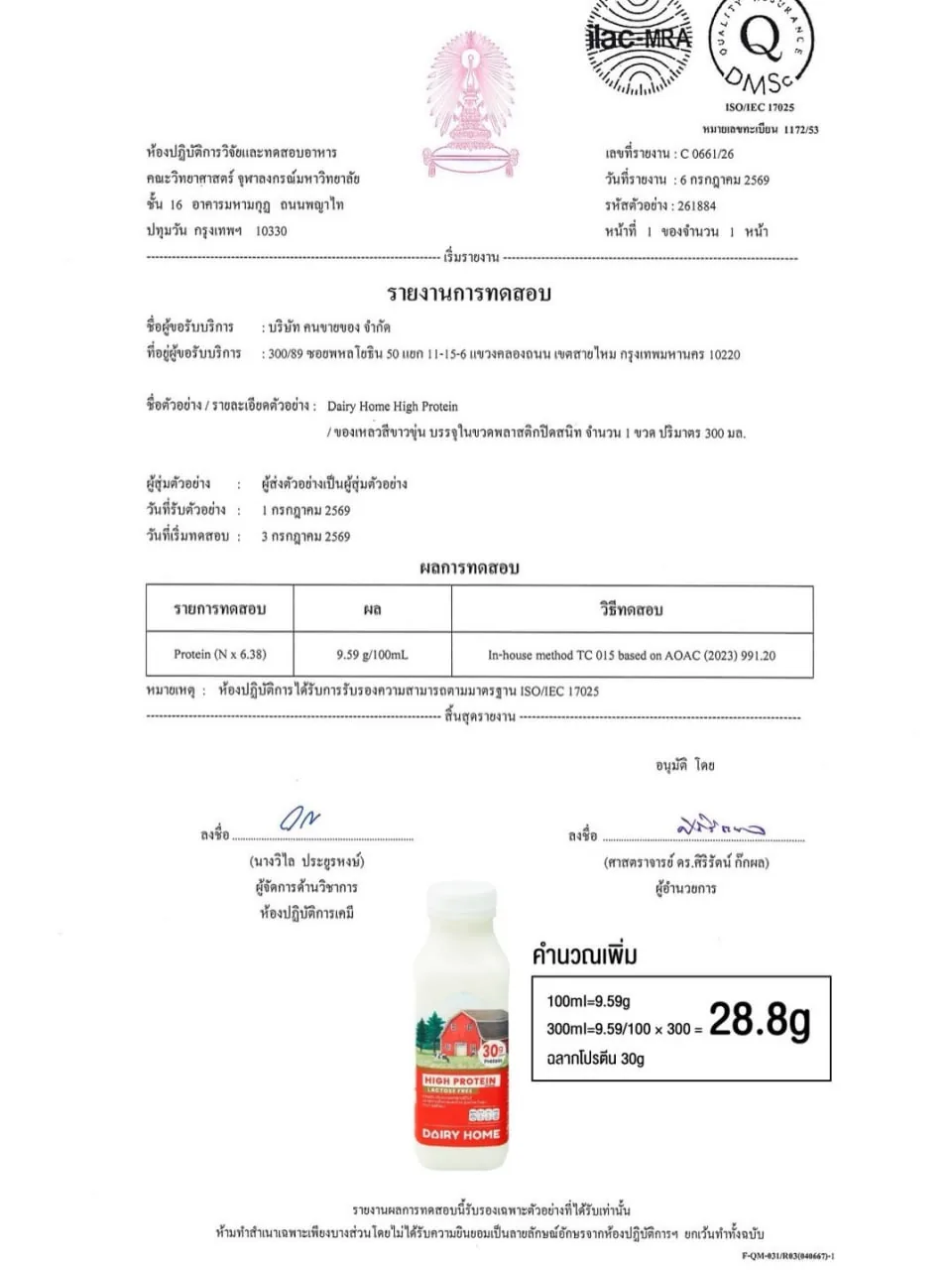
| Dairy Home High Protein | C 0661/26 | 300 mL | 30 g | 9.59 g | 28.8 g | −1.2 g (−4.1%) |
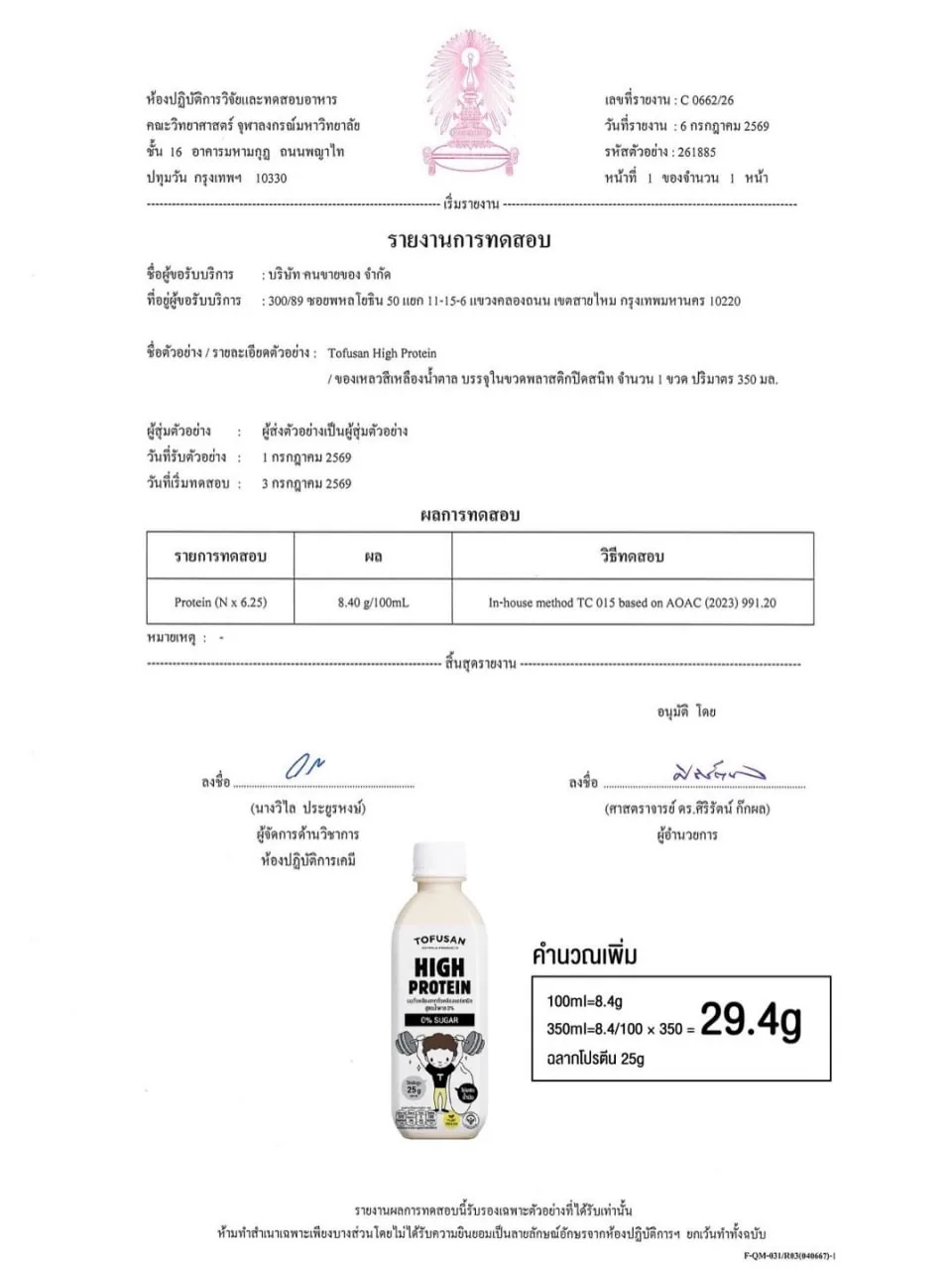
| Tofusan High Protein | C 0662/26 | 350 mL | 25 g | 8.40 g | 29.4 g | +4.4 g (+17.6%) |
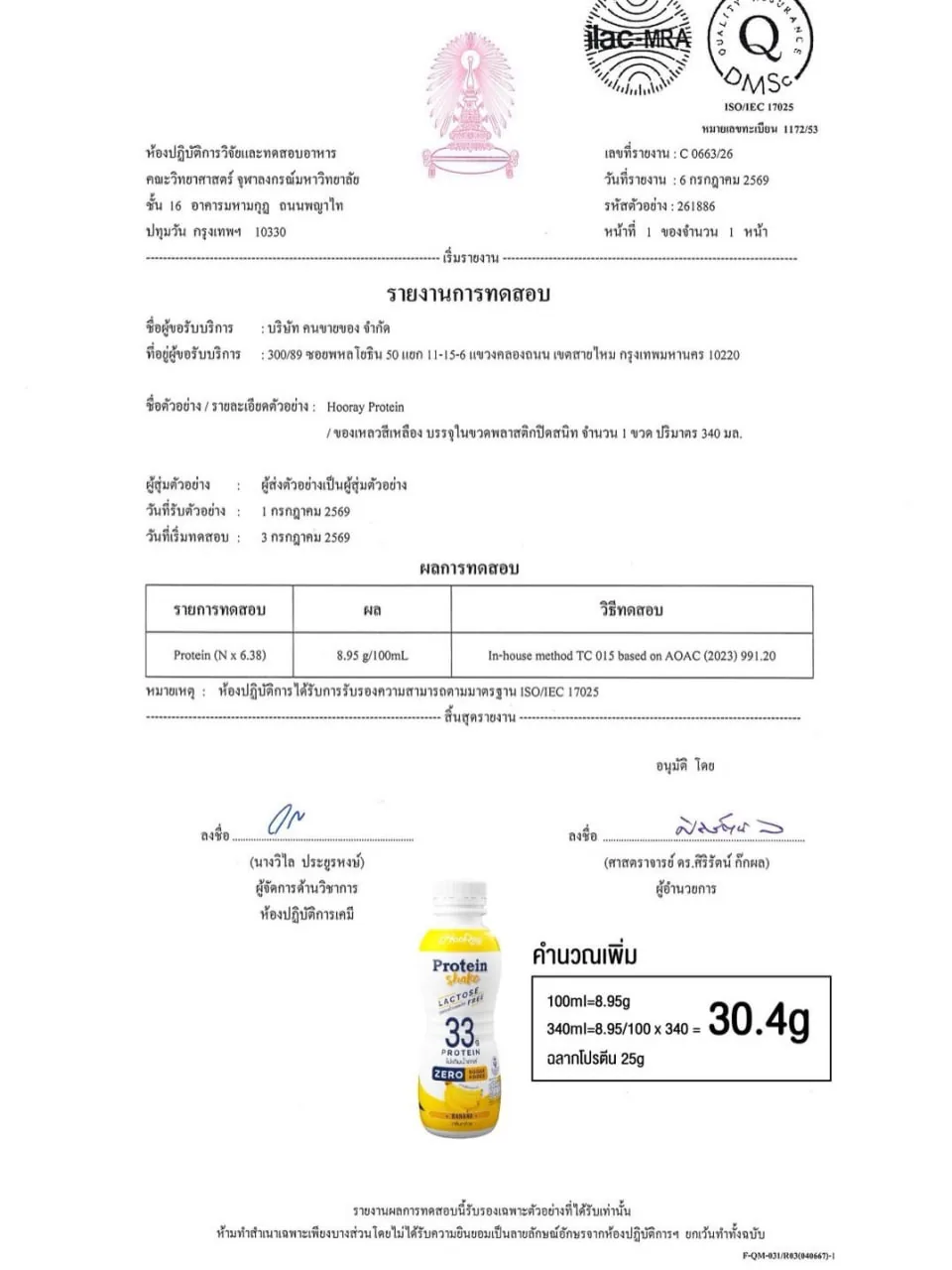
| Hooray Protein Shake Banana | C 0663/26 | 340 mL | 33 g* | 8.95 g | 30.4 g | −2.6 g (−7.8%) |
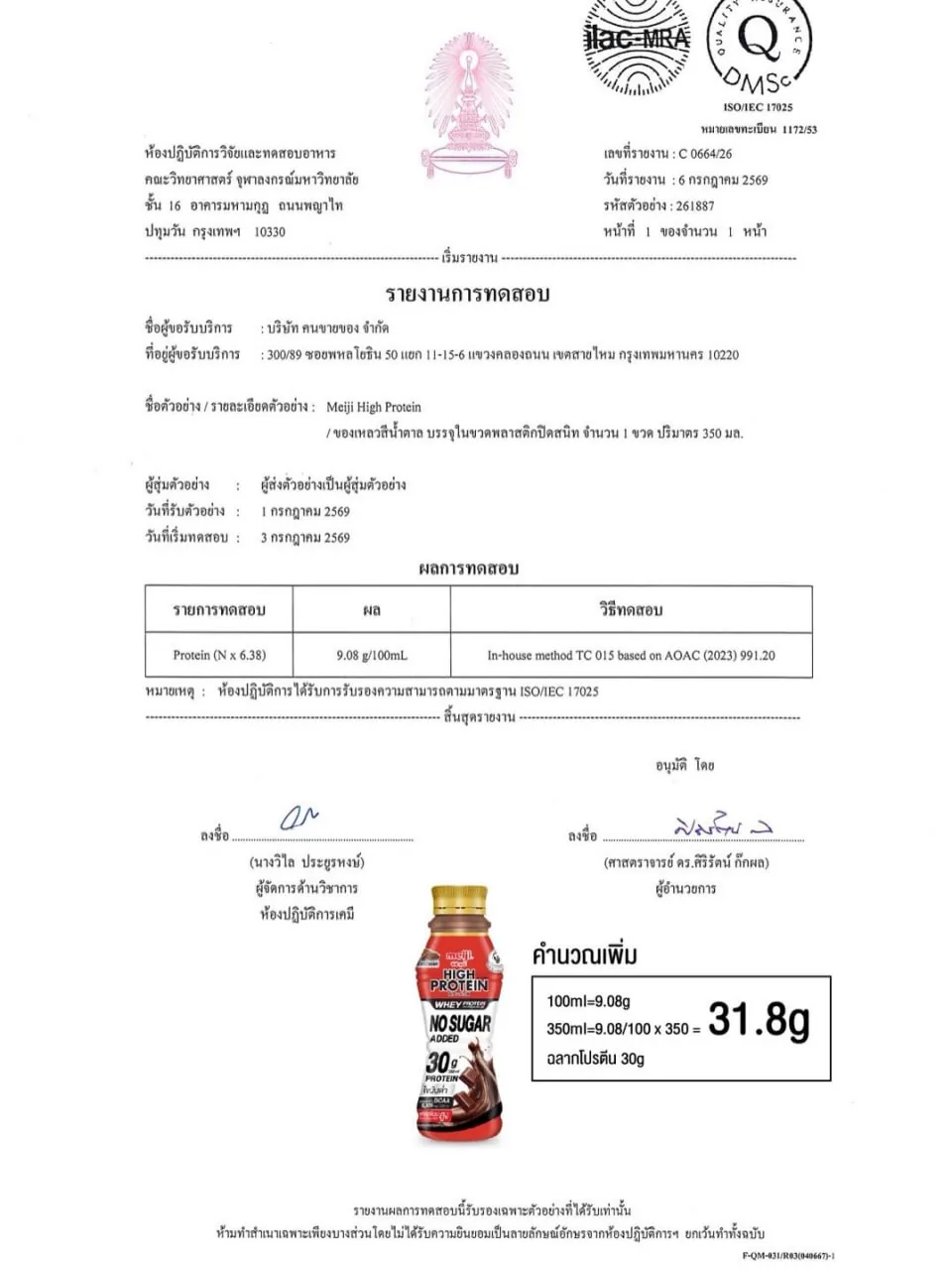
| Meiji High Protein Whey Formula Chocolate | C 0664/26 | 350 mL | 30 g | 9.08 g | 31.8 g | +1.8 g (+5.9%) |
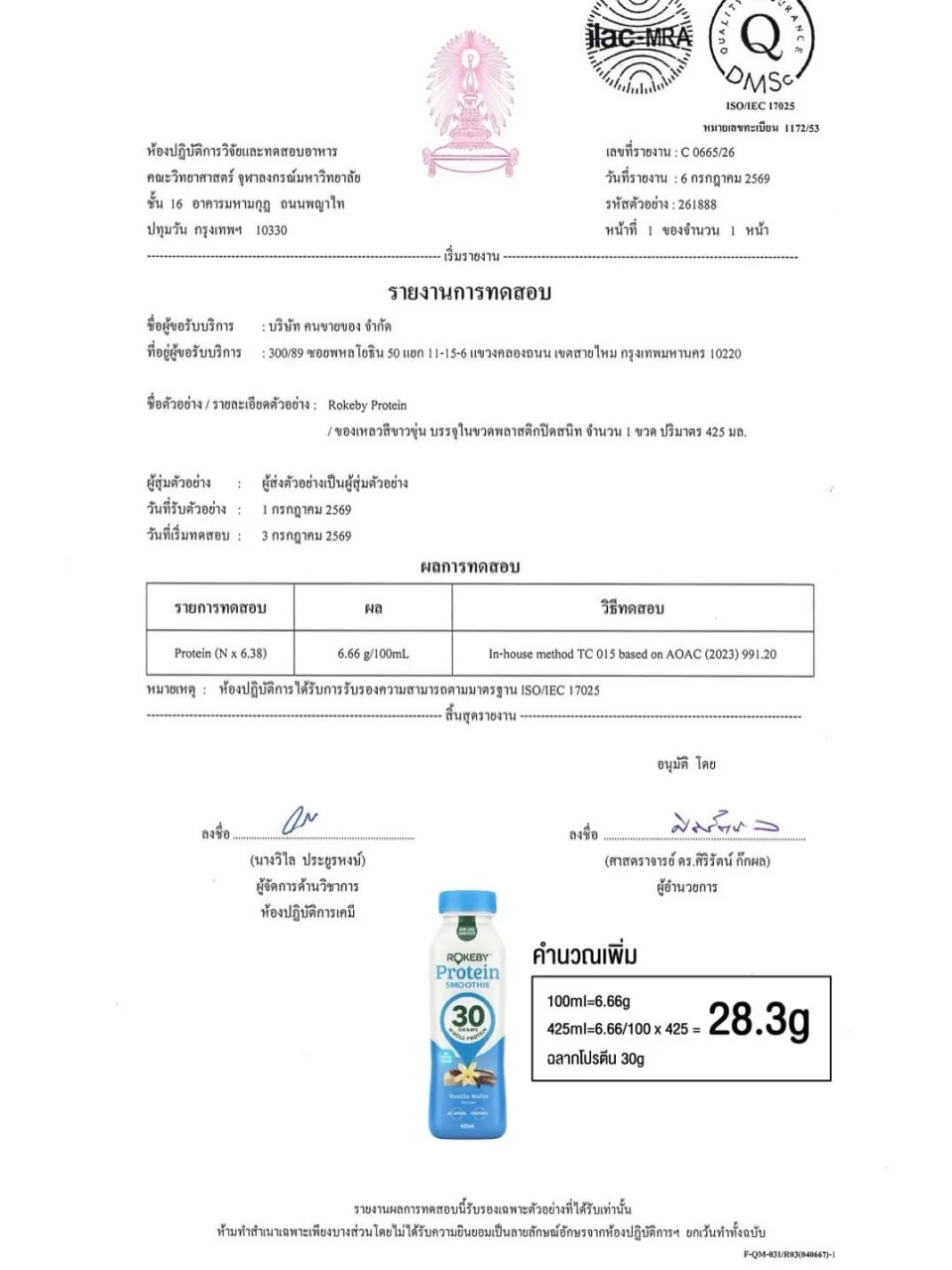
| Rokeby Protein Smoothie Vanilla Wafer | C 0665/26 | 425 mL | 30 g | 6.66 g | 28.3 g | −1.7 g (−5.7%) |
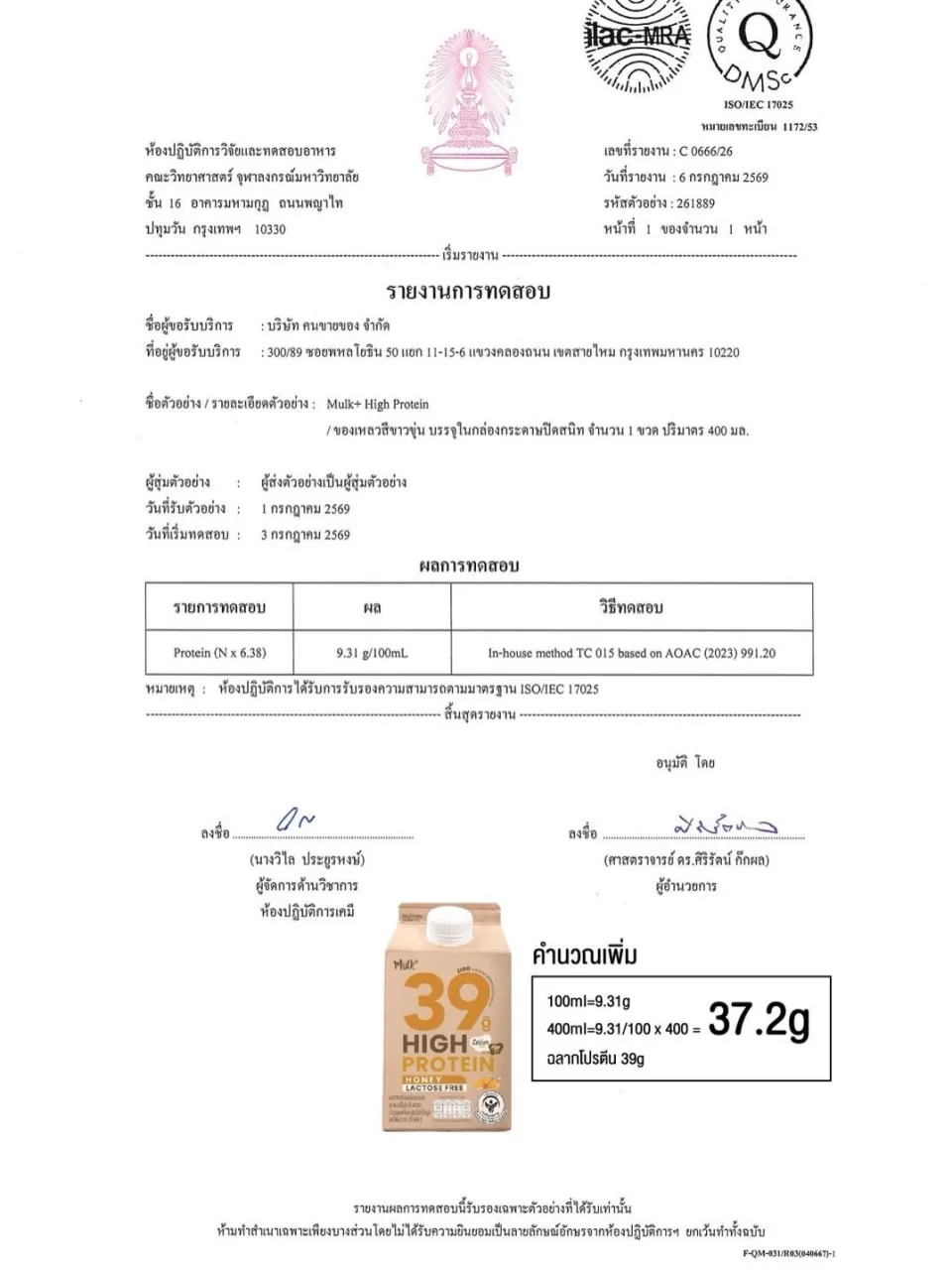
| Mulk+ High Protein | C 0666/26 | 400 mL | 39 g | 9.31 g | 37.2 g | −1.8 g (−4.5%) |
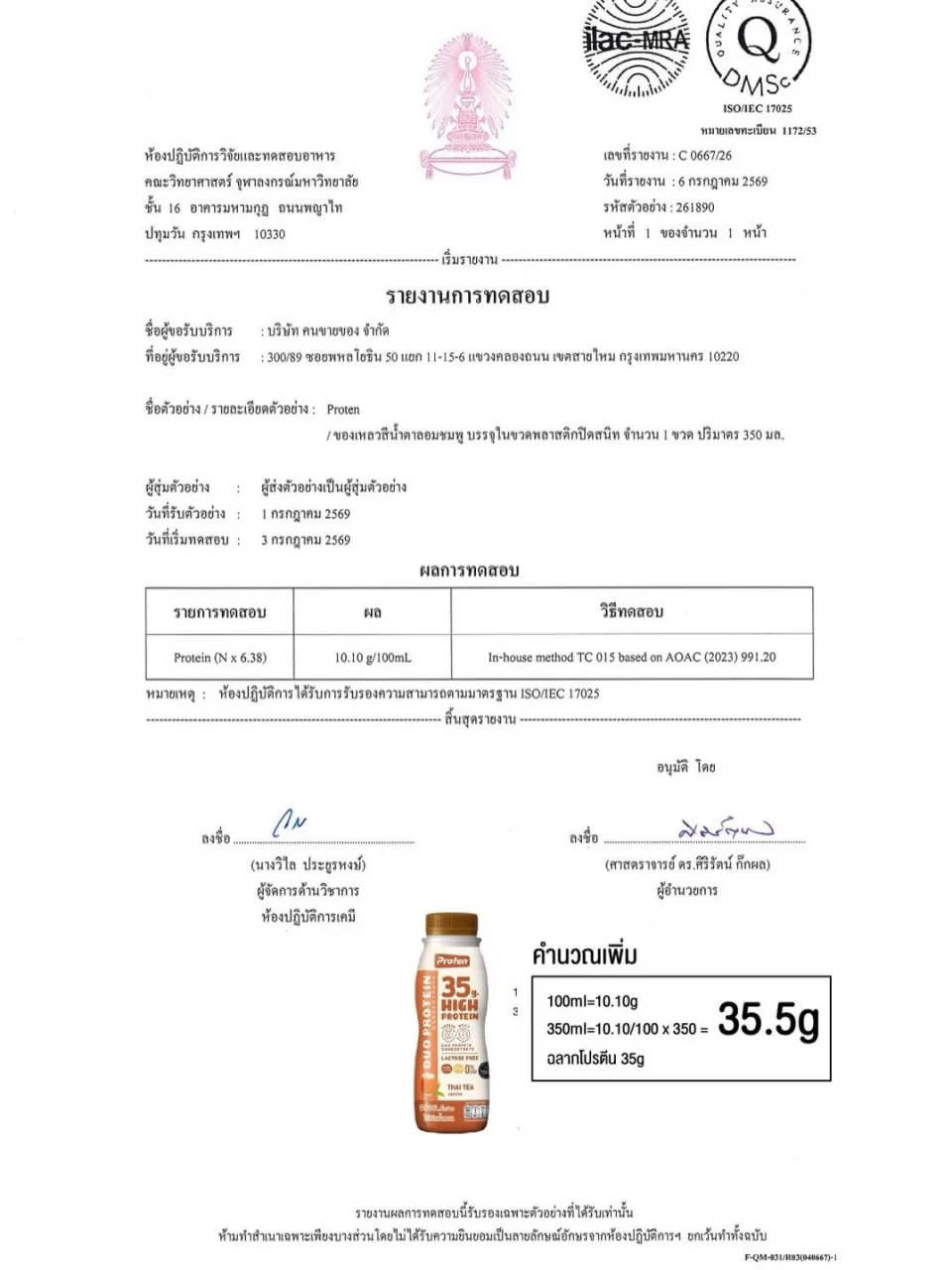
| Proten Duo Protein Thai Tea | C 0667/26 | 350 mL | 35 g | 10.10 g | 35.4 g | +0.4 g (+1.0%) |
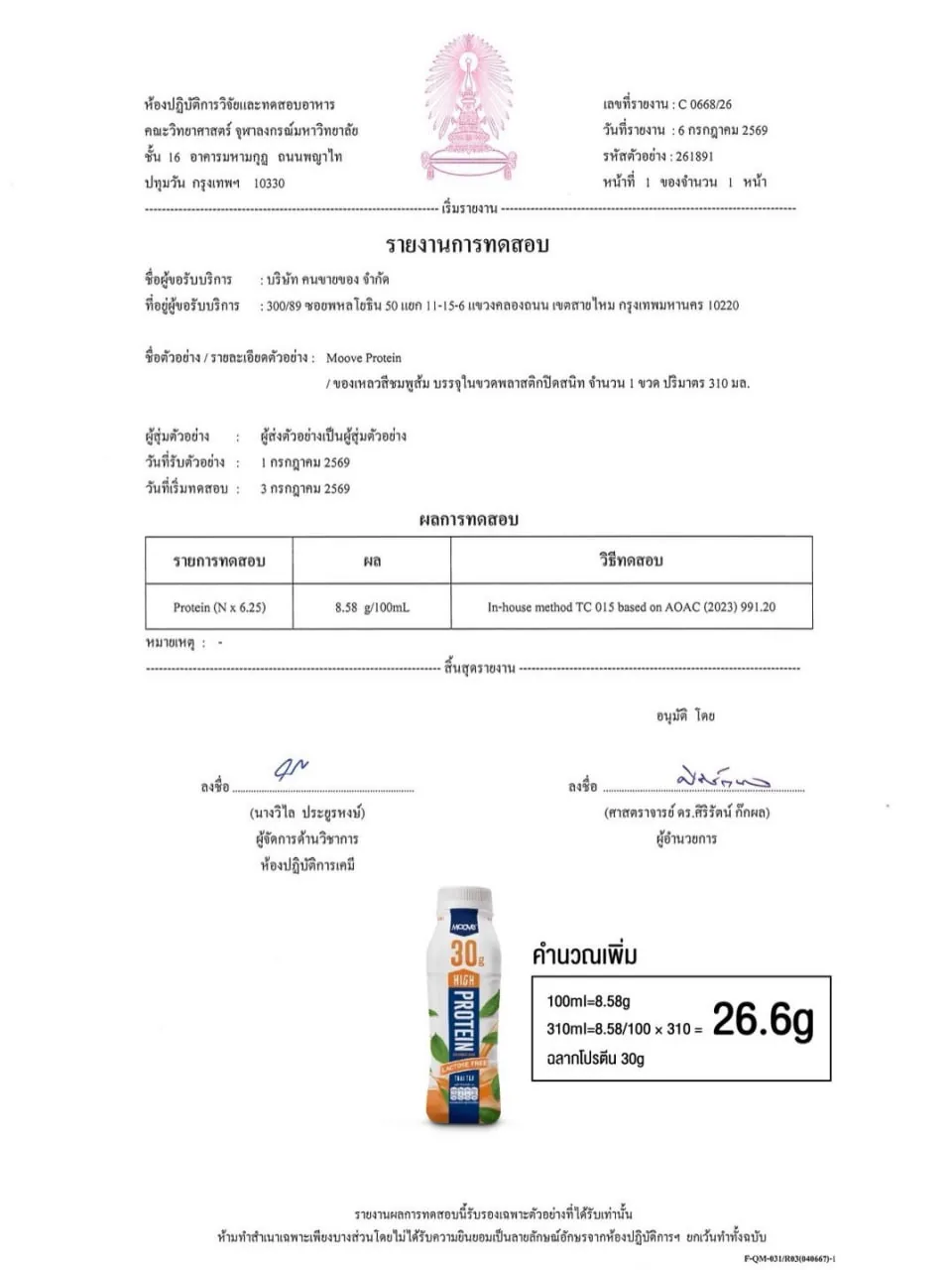
| Moove Protein | C 0668/26 | 310 mL | 30 g | 8.58 g | 26.6 g | −3.4 g (−11.3%) |
*The Hooray comparison graphic says “label protein 25 g,” but its pictured bottle front and the current Hooray banana product page both declare 33 g. We use 33 g and flag the conflict. The Proten graphic prints 35.5 g; the signed 10.10 g/100 mL result multiplied by 350 mL is 35.35 g, which rounds to 35.4 g.
Six products to complete later
These products are now included as unranked candidates. A complete current front label, nutrition panel, ingredients, allergen statement, barcode, and a verified 7-Eleven purchase are still required before any can enter the scorecard.
Mulk+ High Protein
Known now: 400 mL; 39 g front claim; 37.2 g derived from report C 0666/26. A likely exact Open Food Facts record, barcode 8852371970039, matches the 400 mL chocolate product and 39 g claim.
Moove Protein
Known now: 310 mL; 30 g front claim; 26.6 g derived from report C 0668/26. No confident Open Food Facts match or complete label was available, and the report does not establish the flavour or barcode.
Proten Duo Protein Thai Tea
Known now: 350 mL; 35 g front claim; 35.4 g derived from report C 0667/26. Open Food Facts barcode 8851717911064 matches the Thai-tea product and its 35 g claim.
Tofusan High Protein
Known now: 350 mL; 25 g front claim in the supplied comparison image; 29.4 g derived from report C 0662/26 using N × 6.25. The exact flavour and barcode still need a photographed label before matching third-party records.
Dairy Home High Protein
Known now: 300 mL; 30 g front claim; 28.8 g derived from report C 0661/26. Open Food Facts barcode 8858709102196 matches the product, but its nutrition data are too sparse and internally inconsistent to use for scoring.
Rokeby Protein Smoothie Vanilla Wafer
Known now: 425 mL; 30 g front claim; 28.3 g derived from report C 0665/26. The manufacturer nutrition page and Open Food Facts GTIN 9336243005061 both identify the 30 g product.
View all eight complete report images
The supplied one-page documents are reproduced in full rather than cropped. Open any image for the 960-pixel copy.
Methodology, limitations, and label sources
- The five-product ranking is a label-only comparison. The separate laboratory section reports single-sample protein-equivalent results for eight other SKUs; it is not a clinical trial and does not validate the ranked bottles.
- Taste, texture, price, gastrointestinal tolerance, store availability, and individual daily protein needs were not assessed.
- The useful-complete-protein figures for Meiji and Anlene conservatively assume their declared collagen is included within total protein. If the labels exclude collagen from total protein, those estimates would be understated.
- The Anlene, Hooray, and Yendrink photo sets do not show a complete current ingredient statement. Missing details are identified rather than filled from uncertain third-party records.
- The laboratory reports cover one submitted sample of each product. They do not establish batch-to-batch consistency, the purchase venue, or current 7-Eleven availability, and their nitrogen-based method does not distinguish complete protein from collagen or other nitrogen sources.
- “Lactose free” does not mean milk-free. All five products contain milk; Yendrink also contains soy.
- Formulas and package sizes can change. Check the bottle in hand, especially if calories, sweeteners, sodium, or allergens matter to you.
Laboratory report sources
The laboratory section transcribes the signed result tables in the eight supplied complete report images. Product names, report and sample numbers, dates, methods, nitrogen factors, and concentrations come from those documents; derived bottle totals are arithmetic shown transparently in the table. The laboratory’s public service page and the official AOAC method record are linked where the results are introduced.
The reports name บริษัท คนขายของ จำกัด as the client and state that the submitter selected the samples. The English company name in this guide is a transliteration, not a verified official English registration.
Barcode and Open Food Facts cross-checks
The photographed current labels are the source of record for the five ranked products. Open Food Facts was used only to cross-check barcodes and transcriptions; where an entry is incomplete, stale, or conflicting, the photograph wins. For the six lab-only candidates, third-party records are provisional until we photograph the exact bottle.
- Meiji — barcode 8850329101290
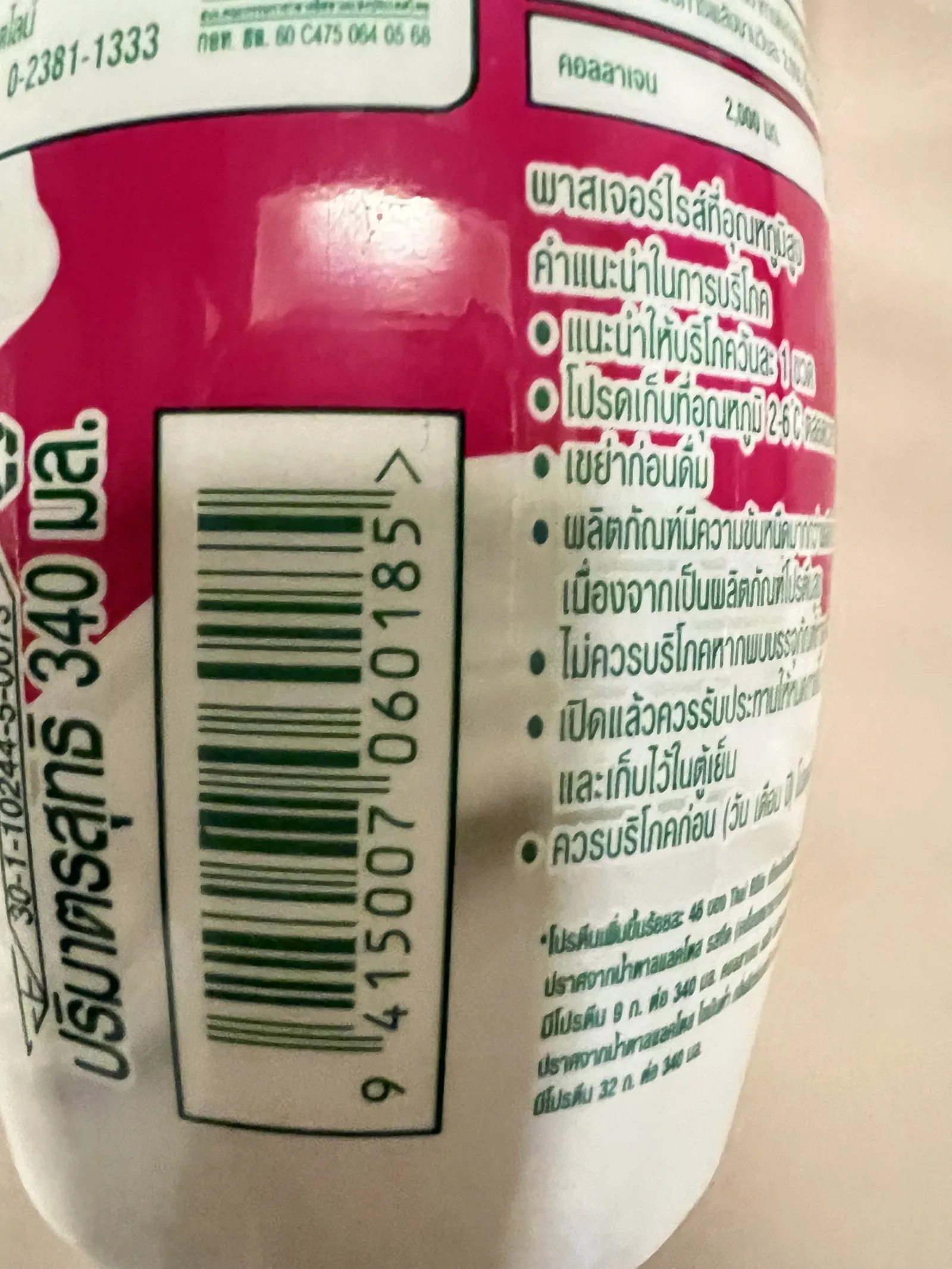
- Anlene — barcode 9415007060185
- Hooray! — barcode 8859488111140
- Sunshine Dairy — barcode 8859473101422
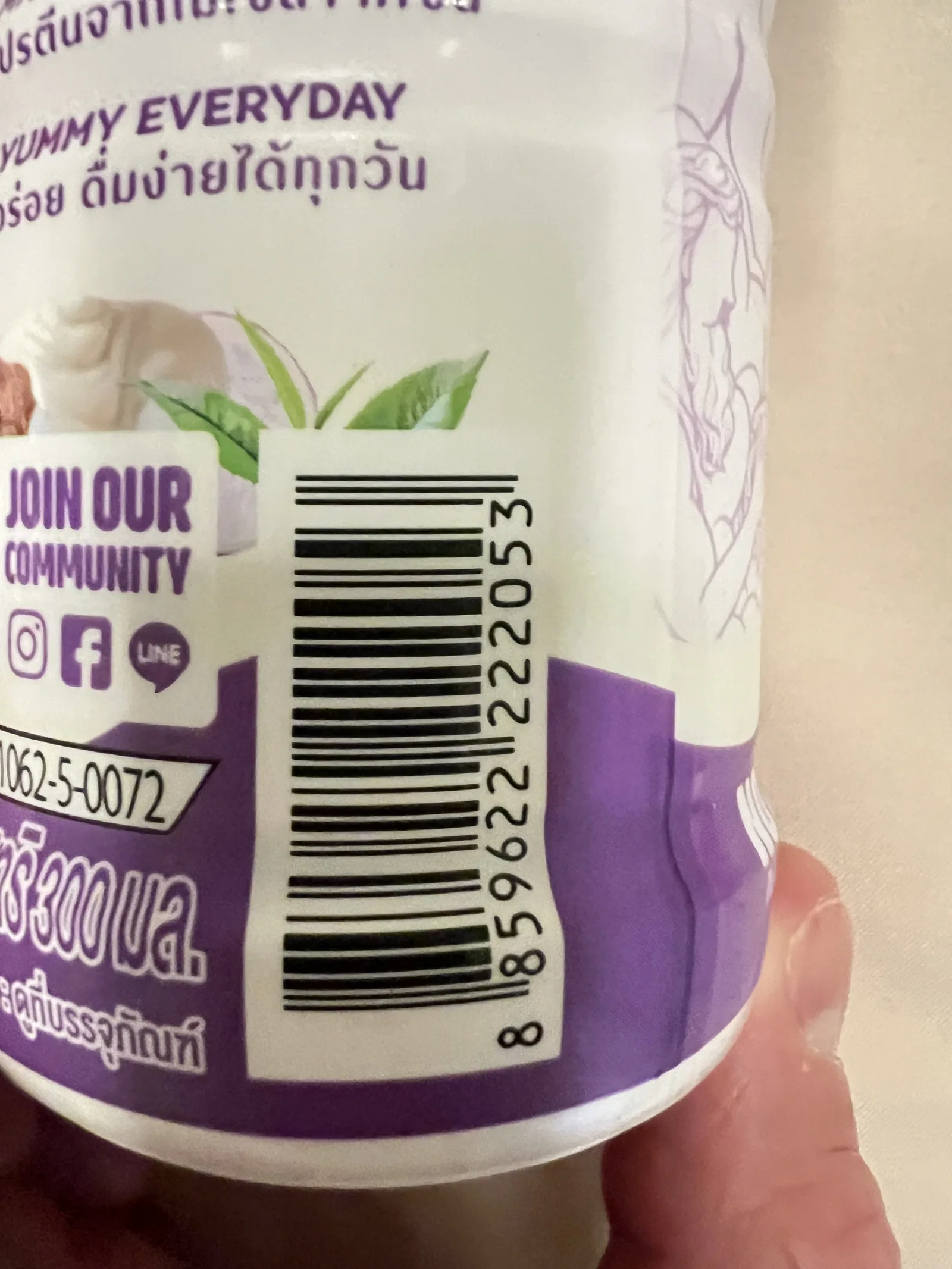
- Yendrink — barcode 8859622222053
The Hooray Open Food Facts record appears to mix an older 30 g/300 mL product with the photographed current 33 g/340 mL bottle. This review uses the photographed current nutrition panel and does not treat the legacy ingredient list as confirmed.