Calculate your daily calories and macros
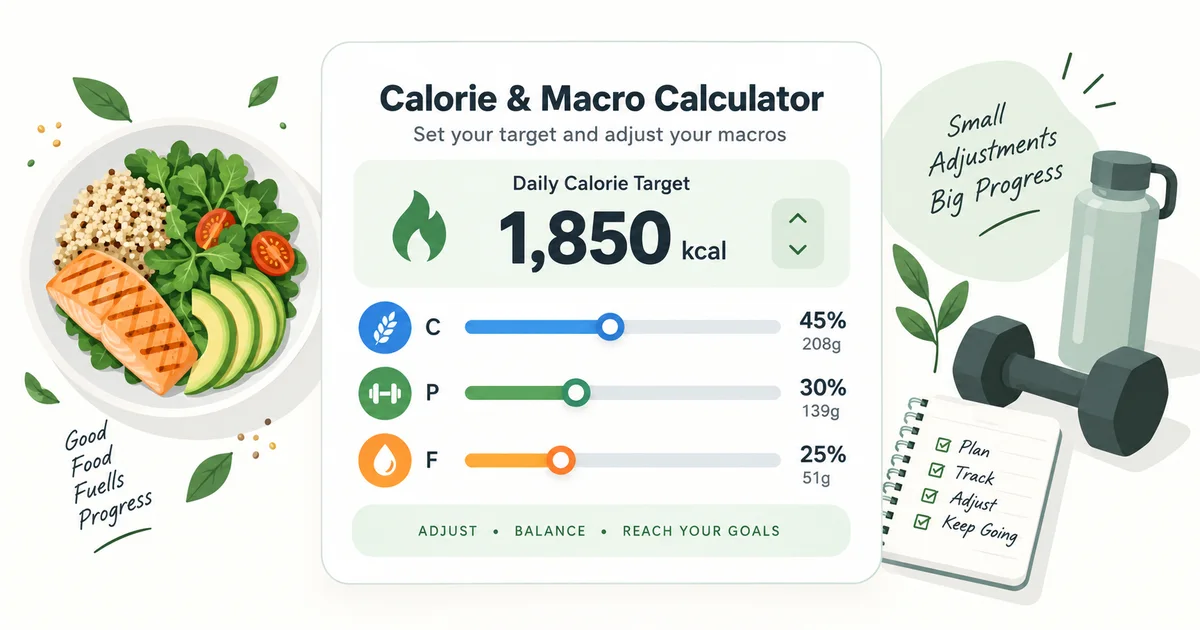
This uses the same core calculation and macro presets as the MyFitMate iPhone app. Complete the details, then fine-tune the macro split. The three sliders remain linked so the total always stays at 100%.
2. Your estimate
Daily targets
- Estimated maintenance
- kcal
- Estimated BMR
- kcal
- Goal adjustment
Rough projection
What could the weight trend look like?
- Estimated change
- Estimated weight
This is a scenario, not a promise. It assumes the planned calorie reduction is followed and uses a simplified first-year version of a dynamic weight-change rule. Real progress may be faster or slower because energy needs, adherence, water weight and activity change over time.
3. Adjust your macros
Carbohydrates, protein and fat
Move any slider and the unlocked macros will share the remaining calories. Lock one macro if you want it to stay fixed.
Private by design: these values are calculated on your device. This page does not submit or save your age, sex, height, weight or targets.
How the estimate works
The calculator first estimates resting energy expenditure with the Mifflin–St Jeor equation. It uses weight, height, age and one of the equation’s two sex-specific constants. That resting estimate is multiplied by the activity level selected above to produce an estimated total daily energy expenditure, or maintenance calories.
The goal then changes that maintenance estimate. Maintenance makes no adjustment. Weight loss allows a 5–25% deficit, and weight gain allows a 5–20% surplus. Both start at 15%, matching the current MyFitMate app calculator.
W is weight in kilograms, H is height in centimetres and A is age in years. The result is an estimate. Real energy expenditure varies, and an activity label cannot capture every job, workout, step count or adaptation.
Choosing a calorie deficit
A deficit means eating less energy than you use over time. The calculator starts at a moderate 15%, but lets you explore 5–25%. A larger number is not automatically better: it may be more difficult to sustain and can compromise training, recovery and lean mass. The calculator avoids promising a fixed rate of loss because the relationship between a planned deficit and real weight change is not perfectly linear.
The CDC recommends gradual, steady weight loss and notes that medication, medical conditions, stress, genes, hormones, environment and age can all affect weight management. If the calculated intake feels unusually low, do not force it simply because a formula produced the number.
The calculator’s 1–12 month projection is deliberately described as a scenario. It is based on the approximate first-year response in a dynamic adult body-weight model, where weight loss slows as the body adapts. It does not use the popular linear 3,500-calorie rule, which tends to overestimate longer-term loss.
For weight gain, the upper limit is lower. Research in resistance-trained people supports using a conservative surplus and reports that faster gain from larger surpluses primarily adds more body fat, rather than proportionally more muscle. The calculator therefore allows 5–20%, while keeping 15% as the app default.
Setting protein, fat and carbohydrates
For weight loss, the MyFitMate calculation starts protein at 2.2 g per kilogram of body weight, assigns 20% of calories to fat and gives the remaining calories to carbohydrates. Maintenance starts at 2.0 g/kg protein and 25% fat; weight gain starts at 2.5 g/kg protein and 27% fat.
Those are practical fitness defaults, not requirements. The International Society of Sports Nutrition position stand places most exercising adults around 1.4–2.0 g protein/kg/day and notes that higher intake may be useful for resistance-trained people during energy restriction. Your food preferences, training volume, tolerance and medical needs still matter.
- Protein: prioritize a target you can meet consistently across normal meals.
- Fat: avoid treating it as a disposable calorie reserve; it is part of an adequate diet.
- Carbohydrates: use the remaining budget to support training, recovery and food preference.
The presets are simply different ways to divide the same calorie target. Selecting “high protein” or “keto” does not make that pattern automatically more effective or appropriate.
How to adjust the target using real results
Step 1
Hold the target steady
Give a reasonable starting target two to four consistent weeks before drawing conclusions. A few individual weigh-ins can be dominated by water, glycogen, salt, travel and digestion.
Step 2
Use an average trend
Compare weekly averages under similar conditions. Look at the direction over time rather than the highest or lowest reading.
Step 3
Check tracking first
Before reducing calories, check portions, drinks, oils, restaurant meals and unlogged weekends. Also check whether your activity changed.
Step 4
Make a small change
If the trend remains flat and adherence is genuinely consistent, adjust by roughly 100–200 kcal/day, then observe again.
Use the MyFitMate calorie counter to log meals and compare your actual intake with the target. The estimate becomes useful when it is tested against your own repeatable data.
Who should not rely on this calculator alone
This calculator is intended as a general estimate for adults. It is not designed for children or teenagers, pregnancy or breastfeeding, eating-disorder recovery, people who are underweight, or anyone whose medical condition or medication materially affects nutrition, fluid balance, appetite or metabolism.
Very low calculated targets deserve individual review. The NHLBI evidence review describes 1,200–1,500 kcal/day for many women and 1,500–1,800 kcal/day for many men as ranges used in weight-loss interventions, adjusted for body weight and activity. Those figures are context, not universal minimums or personal prescriptions.